

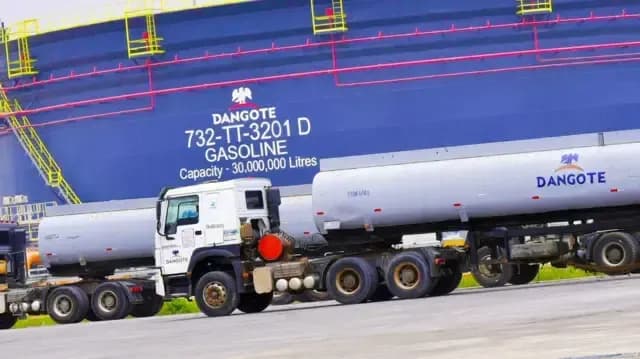
Ghana has confirmed plans to import fuel (gasoline) and other petroleum products from the Dangote Petroleum Refinery, citing limited domestic refining capacity and the need to secure affordable supply for its local market.
The commitment was disclosed at the ongoing Nigerian International Energy Summit (NIES) in Abuja, where Ghana’s downstream regulator said engagement with the Lagos-based refinery has reached an advanced stage.
Ghana targets Nigeria for fuel supply
Speaking at the summit, the Chief Executive Officer of Ghana’s National Petroleum Authority, Godwin Kudzo Tameklo, said Ghana’s existing refineries lack the scale to meet national fuel demand, making imports unavoidable.
According to him, Ghana operates two conventional refineries and a small modular plant with a capacity of about 5,000 to 6,000 barrels per day, which remains insufficient in today’s demand-driven market.
“In the Nigerian context, 6,000 barrels per day is insignificant, but in Ghana it is considered sizeable,” Tameklo said. “Despite that, we have always depended on imports of both crude oil and refined products. Ghana therefore represents a strong offtake market for the Dangote Refinery.”
He added that discussions are already underway with the management of the Dangote Refinery to establish a sustainable commercial relationship that will support regular supply.
Cost, regulation drive cross-border trade
Tameklo said proximity between Nigeria and Ghana makes the Dangote Refinery a natural supply source, noting that shorter logistics chains could significantly reduce fuel landing costs in Ghana.
He stressed that stable macroeconomic conditions and regulatory alignment across African countries remain critical to the success of intra-African energy trade, warning that currency volatility could weaken expected benefits.
“If the Ghanaian cedi is stable while the naira is under pressure, it will limit the gains for consumers,” he said.
The regulator also cautioned against rigid price controls in downstream markets, arguing that poorly designed pricing frameworks can distort competition and weaken industry sustainability.
Drawing from Ghana’s experience, Tameklo said the country fully deregulated fuel pricing after subsidy-related delays in 2015 forced many filling stations out of business. Since then, market-driven pricing has helped stabilise the sector.
Dangote Refinery confirms export capacity
Meanwhile, the Dangote Group has reiterated that the refinery has enough capacity to serve both Nigeria and export markets. The Group Vice President (Oil and Gas), Devakumar Edwin, said the 650,000 barrels-per-day facility is currently operating at about 85 per cent capacity, with steady progress toward full utilisation.
According to him, Nigeria consumes only about 50 per cent of the refinery’s output for fuel and diesel needs, leaving substantial volumes available for regional export.
“We produce Premium Motor Spirit (fuel) and Automotive Gas Oil (diesel). With current demand levels, significant volumes are available for export, and this will increase as capacity utilisation improves,” Edwin said.
He added that several processing units are already operating above design capacity, describing the refinery as a major turning point for Nigeria’s downstream sector after decades of reliance on imported refined products.
Industry analysts say Ghana’s move reinforces Nigeria’s growing position as a regional refining hub, while also highlighting the strategic role of large-scale private refineries in reshaping Africa’s energy trade landscape.