

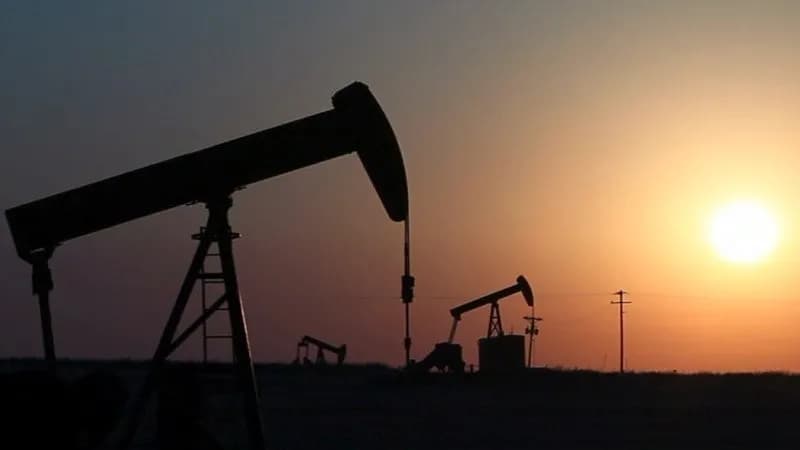
Global oil prices slipped on Monday, weighed down by renewed concerns over the economic health of the United States and China, just days after Goldman Sachs revised its global oil demand forecast upward while maintaining a bearish long-term price outlook.
Brent crude futures fell by 34 cents (0.5%) to $65.07 a barrel in early trading, while U.S. West Texas Intermediate (WTI) dropped 27 cents (0.4%) to $62.22. The retreat follows a week of gains driven by easing U.S.-China trade tensions and growing market optimism.
However, investor sentiment turned cautious after Moody’s downgraded the U.S. sovereign credit outlook, casting a shadow over global economic stability. Simultaneously, new Chinese economic data showed a deceleration in industrial output and retail sales in April, highlighting a fragile path to recovery in the world’s second-largest economy and oil consumer.
“The timing is damaging,” said John Evans of oil brokerage PVM. “The downgrade may not trigger a crash, but its ripple effects on financial markets and investor confidence will be closely watched.”
Goldman Sachs Raises Demand, Keeps Price Forecast Unchanged
Despite the immediate downturn, Goldman Sachs remains confident about increasing global oil demand. In a recent note, the investment bank revised its 2025 demand forecast upward by 600,000 barrels per day, with an additional 400,000-barrel-per-day increase projected for 2026. The revision reflects stronger-than-expected global GDP growth and a potential softening of trade tensions.
“Incorporating lower tariffs and higher GDP,” the bank said, was the basis for its more optimistic demand forecast for the second half of the year.
Still, Goldman maintained its price forecasts for 2025—$60 per barrel for Brent and $56 for WTI—despite both benchmarks currently trading above those levels. The bank expects prices to ease further in 2026, projecting $56 for Brent and $52 for WTI.
Risks: Nuclear Talks and OPEC+ Supply
Goldman Sachs analysts warned that a nuclear deal between the U.S. and Iran could inject volatility into the oil market. Last week, President Donald Trump said the two sides were “close” to an agreement, which briefly pressured prices lower. But subsequent statements from both governments suggested that core disagreements remain unresolved, especially regarding Iran’s uranium enrichment program, which Tehran insists is non-negotiable.
While the diplomatic uncertainty has limited downside risk in the short term, analysts caution that a breakthrough could eventually unlock additional Iranian oil supply, pushing prices lower.
The outlook could become even more bearish if OPEC+ fully reverses the output cuts it introduced in 2022. Under such a scenario, and if trade tensions escalate further to drag down global growth, Goldman forecasts Brent prices could fall to as low as $40 per barrel by late 2026.
Outlook: Demand Up, But Risks Remain
Goldman Sachs’ dual-track view of higher demand but lower long-term prices reflects a complex global energy environment. On one hand, easing tariffs and improving GDP forecasts suggest strong fundamentals for oil consumption. On the other hand, persistent geopolitical risks and structural supply factors continue to cap the market’s upside.
For now, the market remains in a holding pattern. Investors are closely monitoring developments in the Iran-U.S. nuclear negotiations, the trajectory of U.S. fiscal health following Moody’s downgrade, and the strength of China’s economic rebound.
As Phillip Nova analyst Priyanka Sachdeva noted, “While Chinese output beat forecasts, the slowdown points to a bumpy road ahead. Combined with U.S. credit worries, these factors are testing oil’s resilience despite stronger demand projections.”