

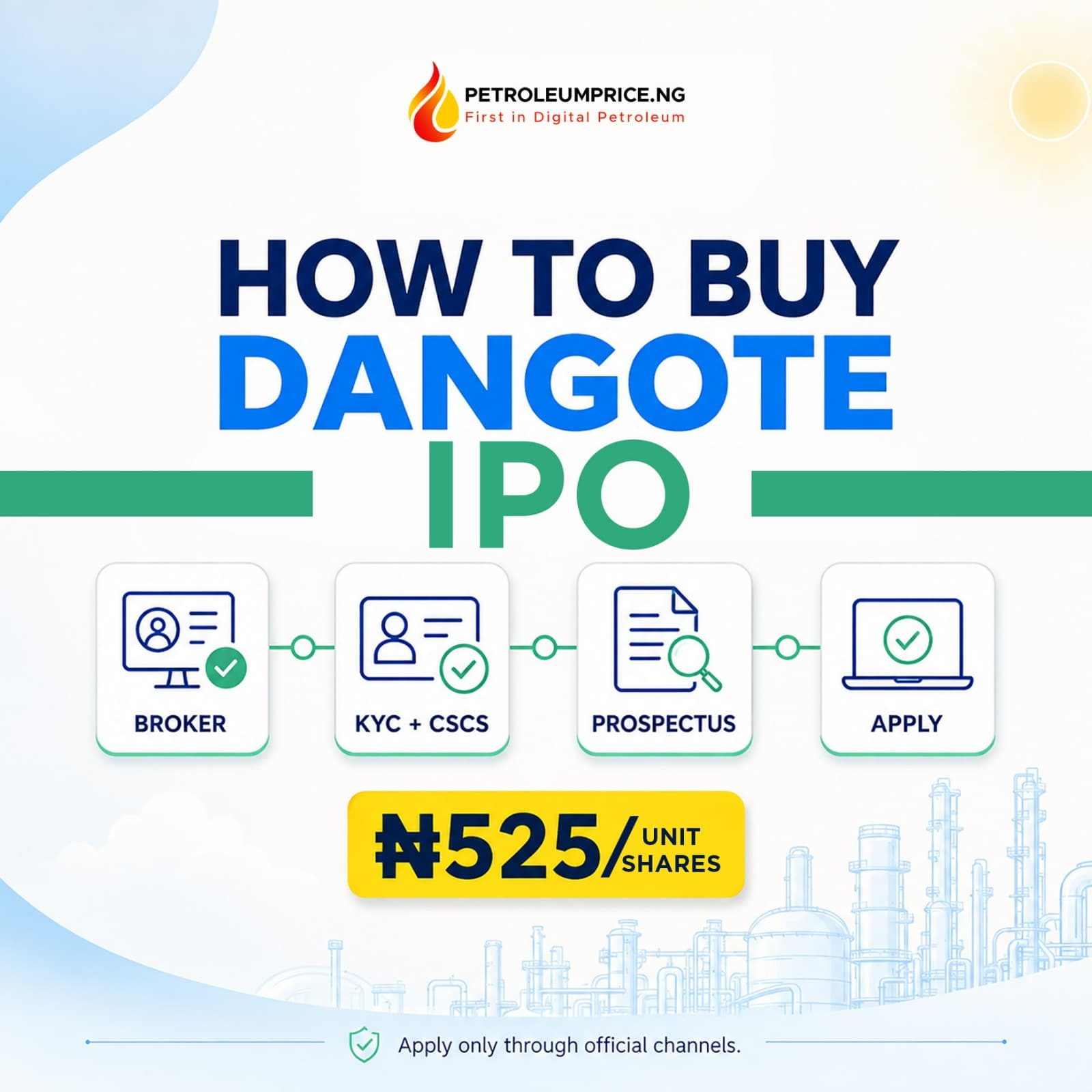
The approval of the Dangote Petroleum Refinery and Petrochemicals FZE initial public offering has opened the way for Nigerians and other eligible investors to take a stake in one of Africa’s largest industrial projects.
The Securities and Exchange Commission has approved the offer of 4.1 billion ordinary shares at ₦525 each, which could raise about ₦2.15 trillion if fully subscribed. The regulator has also registered the refinery’s existing 120.13 billion ordinary shares.
Reuters reported that the order book is expected to open on September 14, 2026, although investors should rely on the final SEC-approved offer documents for the definitive opening and closing dates, application conditions, and other terms.
For first-time investors, the process can be broken down into a series of steps.
1. Open an account with a licensed stockbroker
The first requirement is access to the Nigerian capital market through a registered stockbroker or other authorised receiving agent.
The SEC says investors can participate in a public issue through a registered stockbroker or through the receiving agents identified in the offer document for a primary issue.
Investors therefore do not buy the Dangote Refinery IPO simply by transferring money from a bank account to Dangote Refinery.
A prospective investor should first choose a regulated capital-market operator and complete the broker’s account-opening process. This can generally be done online, although the exact process differs between operators.
Investors should verify that the firm is properly authorised before depositing funds or submitting an application.
2. Complete the required KYC checks
The broker will require identification and other information needed to comply with Know Your Customer and capital-market requirements.
The documents requested can vary between brokers, but may include a valid government-issued identification document, Bank Verification Number, National Identification Number, passport photograph, and proof of address.
The important point for a first-time investor is to complete the verification before the offer opens rather than waiting until the subscription deadline.
3. Ensure your CSCS account is in place
Shares purchased through the Nigerian capital market are held electronically through the Central Securities Clearing System (CSCS).
A prospective investor should therefore ensure that the CSCS account associated with the brokerage account is active and correctly linked.
For many investors, the broker handles the CSCS onboarding as part of the account-opening process. This means an investor may not need to approach CSCS separately.
The CSCS record is important because it reflects the investor’s securities holdings after an allotment has been completed.
4. Decide how much you want to invest
With the offer price set at ₦525 per share, the amount an investor intends to commit will determine the number of shares applied for, subject to the minimum subscription, lot size and other conditions contained in the final prospectus.
For illustration only:
- ₦10,000 would cover approximately 19 shares;
- ₦50,000 would cover approximately 95 shares;
- ₦100,000 would cover approximately 190 shares.
These calculations are before considering any applicable transaction charges and should not be treated as confirmation of the minimum number of shares an investor may apply for.
The final prospectus will determine the applicable minimum subscription and other conditions.
5. Read the approved prospectus before applying
This is one of the most important steps, particularly for first-time investors.
The prospectus should contain the definitive terms of the offer, including the number of shares being offered, offer price, subscription period, minimum application, company information, financial statements, risk factors, use of proceeds and other material disclosures.
The SEC's registration requirements for public offers include the prospectus and supporting documentation as part of the regulatory process.
Investors should therefore avoid making an investment decision solely on social-media adverts, promotional messages or unofficial summaries of the offer.
6. Fund the investment account
Once the investor has completed the necessary onboarding and decided how much to apply for, funds should be made available through the approved application channel.
The amount required will depend on the number of shares being applied for and the final offer terms.
Investors should use only the payment instructions contained in the approved offer documents or provided through their regulated broker or authorised receiving agent.
This is particularly important because the SEC previously warned investors against premature Dangote Refinery IPO solicitations and specifically directed operators to stop accepting deposits, commitments or expressions of interest before regulatory approval.
Now that the IPO has received SEC approval, investors should still distinguish between an official subscription application and unofficial requests to “reserve” shares or guarantee an allocation.
7. Apply when the official subscription window opens
Once the offer officially opens, the investor can submit an application through the authorised channel.
For an online brokerage platform, the process will generally involve:
- Logging into the investment or brokerage platform;
- Selecting the Dangote Refinery public offer;
- Reviewing the offer terms and prospectus;
- Entering the number of shares to be purchased;
- Confirming the amount payable;
- Accepting the required declarations and terms; and
- Submitting the application.
Investors using physical application channels will follow the instructions contained in the prospectus and application form.
The reported September 14 opening date should be treated as an expected date until confirmed in the final offer documentation. Reuters reported that the order book was expected to open on that date.
8. Keep the application details and wait for allotment
Submitting an application does not automatically mean that the investor will receive every share requested.
If demand exceeds the number of shares available, the final allocation may be scaled back according to the basis of allotment approved for the offer.
The SEC’s registration framework specifically provides for a basis-of-allotment process, including a summary of applications and the proposed allocation of securities.
After allotment, successful investors should see their shares reflected in their CSCS accounts.
Where an investor is not allotted the full number of shares applied for, the treatment of any excess application money will depend on the final offer terms and allotment process.
9. Wait for the NGX listing before trading in the shares
Buying through the IPO is different from buying an already-listed share.
At the IPO stage, an investor is subscribing to the primary offer. Once the Dangote Refinery shares are admitted to trading on the Nigerian Exchange, investors will be able to buy or sell the listed shares through the secondary market, subject to the applicable market rules.
The SEC notes that shares can subsequently be sold through a registered stockbroker.
The market price after listing may be above or below the ₦525 offer price. An IPO price is not a guarantee of the price at which the shares will trade once they begin changing hands on the exchange.
10. Continue to monitor the investment
After purchasing the shares, investors should monitor the refinery’s financial performance, production and sales, expansion plans, dividend decisions, corporate announcements and the market price of the stock.
The proposed IPO is intended to raise capital for Dangote Refinery’s expansion plans. Reuters reported that the refinery plans to use the proceeds as part of its strategy to increase capacity from about 650,000 barrels per day to 1.4 million barrels per day.
However, buying shares carries investment risk. The value of the investment can rise or fall, and future dividends are not guaranteed.
For Nigerians considering the IPO, the practical preparation at this stage is therefore straightforward: open an account with a regulated stockbroker, complete KYC, ensure the CSCS account is active, understand the approved prospectus and keep funds ready.
Most importantly, investors should wait for the official subscription window and use only authorised channels when applying.
The SEC’s earlier warning remains relevant: investors should rely on formal regulatory announcements and approved offer documents rather than unsolicited messages promising early access, guaranteed allocation, or pre-IPO placement.