

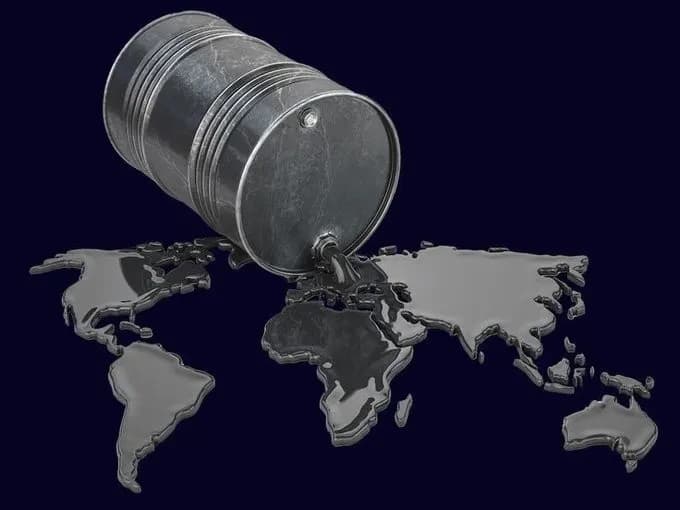
The International Monetary Fund has lowered its global growth outlook and warned that the world economy could edge toward recession if elevated oil prices persist amid an extended conflict involving Iran.
In its April 2026 World Economic Outlook, the IMF projected global output to expand by 3.1 per cent this year under a relatively short disruption scenario, down from an earlier estimate of 3.4 per cent. However, the institution outlined more adverse outcomes if tensions continue, with growth slowing to 2.5 per cent should oil average around 100 dollars per barrel, and potentially weakening further to about 2.0 per cent in the event of deeper supply disruptions and infrastructure damage.
The revised outlook reflects mounting concern over the impact of sustained high energy costs on production, trade, and investment across major economies.
The IMF’s assessment shows uneven resilience across regions. The United States is expected to maintain relative stability, with growth projected at 2.3 per cent in 2026, supported by strong capital inflows into artificial intelligence and digital infrastructure. Large-scale investments by major technology firms in data centres, advanced chips, and related systems are increasingly shaping economic expansion and offsetting some external pressures.
In contrast, China’s growth forecast has been reduced to 4.4 per cent in 2026, with a further moderation to 4.0 per cent expected in 2027. Higher energy costs and rising shipping expenses, particularly along routes linked to the Strait of Hormuz, are contributing to increased production costs for manufacturers. This, combined with ongoing weakness in the property sector, is expected to weigh on industrial output and export competitiveness, although policy support and strategic reserves may help cushion the impact.
India emerged as a relative outlier in the IMF’s projections, with growth slightly upgraded to 6.5 per cent. The improvement is attributed to strong domestic demand, sustained investment activity, and easing trade barriers following tariff adjustments with the United States. Expanding manufacturing capacity, steady services sector performance, and continued infrastructure spending are expected to reinforce the country’s growth momentum.
In Europe, growth prospects remain subdued, with the Eurozone forecast trimmed to 1.1 per cent. The region’s dependence on imported energy continues to expose it to price volatility, particularly as global gas markets react to geopolitical tensions. Rising energy costs have placed additional strain on industrial output and broader economic activity.
The IMF also revised its outlook for oil-producing economies. Growth projections for Saudi Arabia were cut to 3.1 per cent, while the broader Middle East and North Africa region saw its forecast reduced significantly to 1.1 per cent. Disruptions to oil flows and infrastructure challenges linked to regional instability have weighed on output expectations and fiscal balances.
Overall, the IMF’s latest assessment underscores the sensitivity of the global economy to energy market shocks. While some economies continue to show resilience, prolonged high oil prices and supply disruptions could tighten financial conditions, slow trade, and push global growth closer to recessionary territory.