

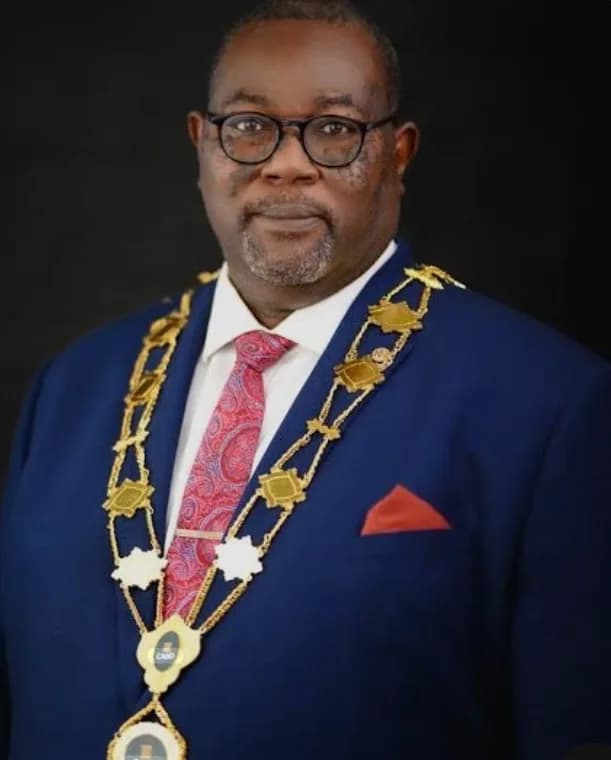
Nigeria's downstream sector is navigating its most consequential transition in decades: deregulated prices, a new large scale refinery, and a generation of operators built on importation now forced to rethink everything. Adetunji Oyebanji, who retired in March 2026 as Managing Director and Chief Executive Officer of 11 Plc after 45 years that began on the floor of what was then Mobil Oil Nigeria, tells Petroleumprice.ng that the industry has come full circle and that the country has earned the right to stop looking backwards.
Take us back to your time as MD. What defined your leadership approach at Mobil Oil Nigeria?
I took over in 2008 and was the second Nigerian to be MD of the company. I walked into big shoes. Somebody had laid the foundation and it was up to me to maintain the standards so that those who had entrusted the company's leadership to Nigerians would not have any cause to regret making that decision. We managed the interface with our multinational owners, who held 60 per cent of the company, and continued to build on the legacy and structures we inherited.
In 2017, our foreign shareholder decided to sell that 60 per cent interest. Suddenly we had a new core investor, and such transitions are never easy. There were a lot of departures, people who left because they wanted to seek other opportunities, and my job was to hold the company together while interfacing with the new ownership. What followed was significant investment in lubricant plants, retail outlets, LPG facilities, and CNG infrastructure. New revenue streams were developed, performance improved significantly, and the company became much leaner and pvery competitive. It has been a period of change which we embraced and took advantage of to take the company to greater heights.
How would you compare the downstream sector during your time to what we have today?
What I can say is that the downstream has gone through a full cycle. When I started my career many years ago, it was more or less deregulated. Oil companies brought in their products, different qualities of gasoline, and they had distribution systems across Nigeria. We distributed via rail and other means. We also had functioning refineries: Port Harcourt, Kaduna, Warri. Those produced bitumen, base oils, and more. Then gradually all those refineries stopped working, importation became the only option, and the military government introduced a fixed nationwide price. As crude prices rose, the subsidy became unsustainable. Now we have a new refinery in place. That is why I say the industry has gone full circle. We have found our way back to where we were many years ago.
I do not think we needed to go through all of that. If the refineries had been maintained, if more investment had come earlier, things would be much better. But now we are trying to find our feet again and I hope that in the future there will be more investment in refining so that there will be more competition in that space.
How did you navigate government policy shifts and regulatory pressures during your era?
As we always said, we are marketing companies. Government sets policies for the nation, for the economy, for various industries. If you want to survive long term, you have to learn to adapt. When local refineries stopped working, everybody turned to imports. When the subsidy regime came into play, we adapted to that too. Now we are in a deregulated market.
My own company has probably been the longest surviving in this space, even though it is under different ownership now: Mobil Oil Nigeria Limited, then Mobil Oil Nigeria PLC, now 11 Plc. I was MD from 2008 through to my retirement and during that whole time, we just had to adapt and deal with the changing landscape. Those who were not able to adapt either sold out or moved on to doing other things entirely.
Nigeria is now seeing increased local refining, something that was long anticipated in your time. Does the current reality match expectations?
To a large extent, yes. Importing is a more complex activity: banks, letters of credit, offshore suppliers. It is not rocket science, but it is more complex than having a local supplier where you can just pay for the product locally and it is delivered to you by vessel or you go to pick it up. The supply chain is shorter when there is a local refiner, and in many respects it has met the expectation.
The only thing is that it would have been nicer if there were several local alternatives rather than a single entity. In a situation where there is only one supplier, the people who buy from it are at the mercy of that entity. But is it not better than having to import? Yes, I definitely think it is much better. Whoever moves first, whoever makes the investment, should by definition enjoy the benefits of taking that risk. Eventually, when more competition comes, the consumer will be better off for it.
Do you believe the industry is on a better path today than when you left it?
Oh, yes. When a game changer like a new big refinery comes into play, there is going to be a lot of shaking and moving within the industry. Some people may not even be able to survive the change. But ultimately the industry is better off, other refineries will come on stream, and the worst period has passed.
The most telling sign for me is something very simple: the queues are gone. People no longer spend days at the petrol station waiting for fuel. In a deregulated market, pump prices respond to global inputs, and a great deal of the recent increase has been driven by the Iran US Israel conflict, which pushed Brent crude above $100 a barrel at its peak as disruptions to the Strait of Hormuz choked global supply. But markets move in both directions. When conditions ease, prices will come down. I can assure you of that.
There are voices calling for a return to fuel subsidy given elevated pump prices. What is your position?
I do not think it is realistic, and I think it would be a serious mistake. Any time the government was forced to increase the pump price under the subsidy regime, the country would almost come to a standstill. The unions would raise problems, there would be meetings upon meetings. That was not good for the economy. How long can we keep doing that as a nation?
When prices are set by the market, people make judicious decisions because of their purchasing power. If the price of diesel goes to 2,000 naira, you start seeing people asking: what other alternatives can I find? Some now run wholly on solar. Many of those operating tanker trucks have switched to CNG because it is a cheaper source of energy. By subsidising, you are taking money away from the federal government that it should invest in health, roads, and education.
And consider who actually benefits. To fill some of those large jeeps on Nigerian roads today costs around 150,000 naira. If you go to Europe, most people drive small cars with small engines because they pay a realistic price for fuel. Subsidising petrol is, in many respects, a transfer of public money to those who already have the most. What government should do instead is target support directly at the vulnerable: free public education, subsidised public transport, affordable healthcare. That is more meaningful than keeping pump prices artificially low. A return to subsidy takes us back to a cycle we have only just managed to break.