

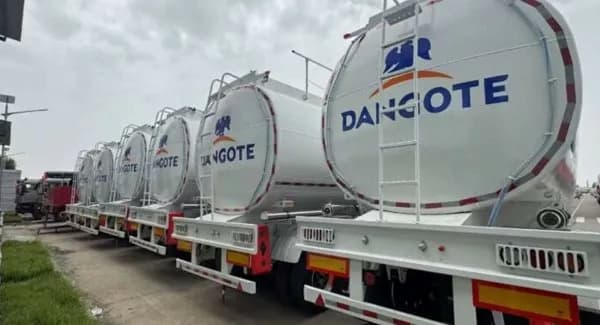
With just weeks to go before the anticipated rollout of 4,000 Compressed Natural Gas (CNG) trucks by Dangote Petroleum Refinery, key players in Nigeria’s downstream oil industry are split over the implications of the ambitious logistics initiative. While some independent marketers see it as a lifeline amid high fuel distribution costs, other stakeholders raise red flags over potential job losses and long-term market disruptions.
As of July 18, Dangote’s refinery had secured distribution agreements with at least 25 petroleum marketers, up from just three at the programme’s inception. These partnerships will enable the refinery to begin direct fuel supply to retail outlets, manufacturers, and high-volume consumers nationwide from August 15. This reflects rapidly expanding support for the company’s vertically integrated supply model.
A senior official at Dangote Refinery confirmed that more marketers have been signing up ahead of the planned rollout of 4,000 trucks for free petroleum product distribution.
IPMAN: ‘We Have No Choice’
The Independent Petroleum Marketers Association of Nigeria (IPMAN) acknowledged the refinery’s dominance in Nigeria’s refined products market. The association said its members feel compelled to partner with Dangote out of necessity.
“We don’t have any option. Dangote has become the only supplier of petroleum products in Nigeria and West Africa,” said Chinedu Ukadike, IPMAN’s National Publicity Secretary. “Marketers have applied to benefit from the free distribution scheme.”
He argued that aligning with Dangote’s logistics model could help reduce pump prices and boost retail profitability. “Sometimes we don’t even finish one truck in a month because of high fuel costs. Our running costs don’t stop. If this plan lowers pump prices, it helps us.”
Yet, Ukadike expressed concern about market concentration. “We urge other refineries to come on stream. Monopoly isn’t sustainable, and government-owned refineries need to step up,” he said.
PETROAN: ‘Beware the Greek Gift’
In contrast, the Petroleum Products Retail Outlets Owners Association of Nigeria (PETROAN) urged caution. Its President, Billy-Gillis Harry, warned that the refinery’s direct supply model may eventually replicate past monopolies seen in Nigeria’s cement, flour, and sugar industries.
“I think Nigerians need to be careful about accepting a ‘Greek gift’. We’ve seen this in cement. The prices never came down,” he said. “If smaller players are driven out, we could end up buying petrol for ₦2,500 per litre. We’re bold enough to stand by our point.”
NARTO: Silence as Consultations Continue
Meanwhile, the National Association of Road Transport Owners (NARTO), whose members could face the most impact from the logistics shift, has yet to take a clear position. NARTO’s National President, Yusuf Othman, confirmed that consultations with stakeholders are ongoing but declined further comment.
“I’m not going to say anything about it because we are in discussion,” he said.
The planned deployment of Dangote-owned trucks has sparked anxiety among tanker drivers. Many fear that the widespread adoption of the free delivery model could render their roles obsolete. While some drivers may join Dangote’s fleet, others risk redundancy.
A logistics analyst warned, “Some marketers may park their trucks to enjoy free delivery. This could severely disrupt the livelihoods of thousands of independent drivers.”
Suppliers and Drivers Alarmed
Further discussions will take place at a scheduled National Executive Council meeting of the Natural Oil and Gas Suppliers Association of Nigeria (NOGASA) on July 31. NOGASA members worry that Dangote could bypass traditional supply chains by selling directly to industries and telecom firms. That move could sideline long-standing suppliers and their drivers.
Observers see Dangote’s logistics overhaul as part of a broader market transformation driven by local refining and integrated supply. The 650,000 bpd refinery started operations in January 2024 and began producing PMS by September of that year. By early 2025, it had reached 85% of installed capacity.
While the Dangote Group maintains that its goal is to ensure availability and affordability, critics warn that unchecked market dominance could mirror earlier trends of declining competition and eventual price increases.
The industry continues to monitor developments closely as Nigeria’s downstream fuel dynamics shift toward a more vertically integrated, privately led model.