

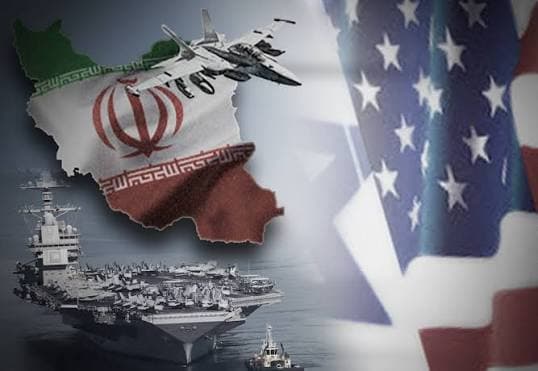
Iran has declared that US forces will no longer be permitted to operate in the Persian Gulf, the Gulf of Oman, or the Strait of Hormuz, while its military has announced a $30,000 reward for anyone who kills or captures an American soldier.
Iranian Army Commander Major General Amir Hatami made the statements on Sunday, escalating Tehran’s confrontation with Washington as fighting continues around southern Iran and the strategic waterway.
Hatami said the expulsion of US forces from the region had already taken place and that Iran would prevent American military bases and facilities in neighbouring countries from returning to their previous status.
He described the Strait of Hormuz as a strategic asset whose importance had grown significantly during the conflict, arguing that Iran would use its control of the waterway as leverage to remove the threat of further war.
According to Hatami, Iran had long understood the strategic value of the strait, but recent developments had demonstrated its potential as a major bargaining tool. He said any cost associated with preserving that strategic position would be justified.
The commander also said the strait had become one of the conditions for ending the war, suggesting that its future status would form part of any eventual settlement between Tehran and Washington.
Separately, Hatami announced that the Iranian military would pay 5 billion tomans, equivalent to roughly $30,000, to anyone who kills or captures and hands over an American military personnel.
He said the reward was introduced following what he described as a large number of requests from people seeking to participate. Hatami did not specify where or when such attacks were expected to take place.
He added that Iranian women who successfully carried out such an action would receive twice the standard reward.
There have been no known deployments of US ground troops inside Iran during the conflict, apart from a major rescue operation in April involving efforts to recover the weapon systems officer of a downed US F-15 fighter.
The April operation involved around 200 US troops and more than 170 aircraft. Iranian forces damaged an A-10 ground-attack aircraft during the operation, while US forces reportedly abandoned and destroyed some aircraft involved in the mission, including a C-130 transport plane.
The F-15 crew member was eventually rescued by helicopter.
The conflict began on February 28, when the United States and Israel launched attacks on Iran. After nearly 40 days of fighting, the two sides reached an April ceasefire, followed by a framework for peace negotiations in June that subsequently collapsed.
Fighting has since resumed intermittently, with much of the confrontation concentrated in southern Iran and around the Strait of Hormuz.
Indirect contacts between Tehran and Washington have continued through mediators, although there has been little indication of a diplomatic breakthrough. Iran has also demanded compensation for war-related damage as part of conditions for reopening the strait.
Hatami said Iran would defend the waterway with all available capabilities and rejected any return to the previous security arrangement in which US forces operated in the area.
He also argued that the conflict had weakened the perception of US military dominance and encouraged countries in the region to pursue more independent security strategies.
At least 17 US military personnel have been killed since the conflict began, according to the information cited in the reports. The deaths have occurred outside Iran, including in Jordan and Iraq.