

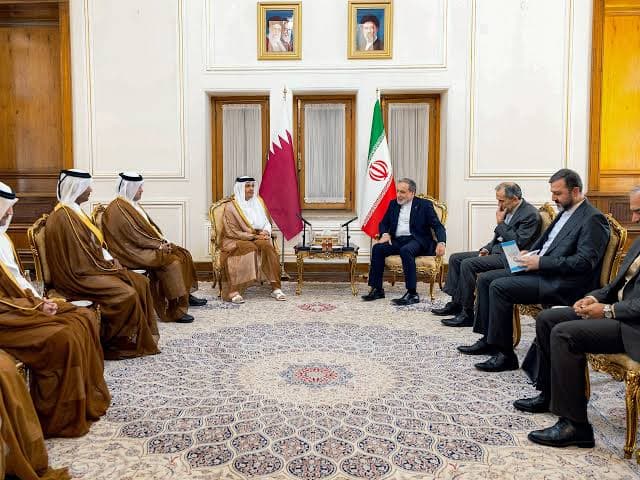
Iran has dismissed proposals presented by Qatari mediators to end its eight-month war with the United States and Israel, describing the ideas as unacceptable and signalling that disagreements over its nuclear programme and economic restrictions continue to obstruct diplomatic efforts.
A senior Iranian official involved in the negotiations said Tehran had received ideas from Qatar but did not consider them a formal offer. The official also maintained that Iran would not soften its position on the nuclear issue.
The rejection contrasts with an earlier account from an official familiar with the negotiations, who said Qatar had delivered a new draft agreement to Tehran on Sunday and that Iranian authorities were reviewing it. The official, who was not Iranian, expected a response by the end of the week.
According to that account, the proposal outlined a seven-day process involving daily confidence-building measures intended to address concerns on both sides. The timeline could begin early next week, with several countries serving as guarantors of an eventual agreement.
The precise terms of the draft were not immediately available. However, the official said it differed from an earlier seven-day proposal put forward by Iran in late September.
Qatar and Pakistan have taken leading roles in efforts to halt the conflict, which began with U.S. and Israeli attacks on Iran on February 28. The fighting has disrupted international shipping and energy supplies and expanded to involve additional fronts in the Middle East.
The central disagreement remains the sequence of steps required to end the war. Washington wants Iran’s nuclear programme included in negotiations from the outset, while Tehran insists that its conditions must first be addressed.
Iran is demanding an end to the U.S. blockade of its ports and the removal of sanctions on its oil exports. It also rejects Western allegations that its nuclear programme is intended to develop nuclear weapons.
The latest diplomatic initiative follows the failure of an earlier effort in September, when Iranian Foreign Minister Abbas Araqchi proposed a seven-day arrangement under which the Strait of Hormuz could be reopened if certain conditions were met. U.S. President Donald Trump rejected that proposal, prompting further mediation by Qatar.
The latest draft was reportedly coordinated with Washington before Qatari representatives travelled to Tehran, according to the official familiar with the negotiations.
Diplomatic efforts are unfolding amid renewed fears of further military action. Before Sunday's meeting in Tehran, the official said there had been concerns that Israeli Prime Minister Benjamin Netanyahu could order fresh attacks on Iran during the week as he campaigns for another term in office.
Trump also renewed his threats to strike Iran on Friday. Iranian security officials, meanwhile, told Reuters that Tehran had prepared detailed plans to target undersea cables in the Gulf if the United States and Israel resumed their attacks.
Regional governments have intensified their efforts to prevent the conflict from escalating further. Senior officials from Saudi Arabia, Turkey and Pakistan met Iranian representatives in Tehran on Monday as part of a broader de-escalation initiative.
Qatar said on Tuesday that Iran needed to end threats against Arab Gulf states and reopen the Strait of Hormuz to demonstrate its commitment to a successful diplomatic process.
The security situation deteriorated further after Yemen's Iran-aligned Houthi movement intensified attacks on Saudi Arabia, a key U.S. ally and the world's largest crude oil exporter.
Oil prices climbed by more than one per cent to above $115 per barrel on Wednesday following a Houthi attack on Saudi Arabia's Ras Tanura refinery, raising concerns about the security of regional energy infrastructure and the potential for further supply disruptions.
The refinery is one of Saudi Arabia's major oil-processing facilities. The attack came as fighting involving the Houthis intensified last month, with the group advancing against Saudi-backed forces towards the Bab el-Mandeb Strait, a strategic shipping route connecting the Red Sea to the Gulf of Aden.
The Strait of Hormuz and Bab el-Mandeb are both critical to international energy transportation, making renewed hostilities around either passage a potential threat to oil shipments and shipping costs.
The war has also reignited fighting between Israel and Hezbollah, the Iran-backed armed group in Lebanon, widening the conflict beyond Iran and the Gulf.
Earlier in the war, sustained attacks affected Gulf states and critical infrastructure across the region. The expanding conflict has heightened uncertainty over the security of energy supplies and the prospects for a durable ceasefire.
The prolonged hostilities have also put pressure on Trump's domestic political standing ahead of the U.S. midterm elections, which will determine control of Congress.
For now, the latest Qatari initiative has yet to produce an agreement. Tehran's rejection of the ideas presented by Doha, combined with continuing disagreements over nuclear policy, sanctions, maritime security, and military threats, leaves the prospects for ending the war uncertain.