

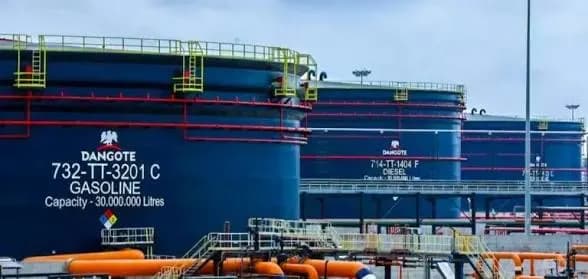
The Dangote Petroleum Refinery has temporarily suspended gasoline exports, sources familiar with the development told Petroleumprice.ng, in a move that appears to redirect available supply toward the Nigerian market.
The decision comes at a time when the 650,000-barrels-per-day refinery remains a major supplier of petrol to the domestic downstream sector, with market participants noting that the shift could influence product availability across local distribution channels.
A source with knowledge of operations said the export suspension is aimed at prioritising local supply, although no official timeline has been provided for the resumption of overseas shipments.
The development has also raised questions within the industry, particularly as it coincides with reports of operational constraints within key sections of the refinery.
Petroleumprice.ng had earlier reported maintenance activities across parts of the facility, a situation market participants said could temporarily affect production levels and export capacity.
While the refinery has not offered an official explanation, industry sources said the export pause may be linked to a combination of factors, including reduced output from critical processing units and broader operational adjustments within the plant.
Analysts point to recent performance data from the refinery’s Residual Fluid Catalytic Cracking (RFCC) unit, which is central to gasoline production. Independent monitoring firm IIR Energy, cited by Reuters, estimated that the unit has been operating at about 66 percent of capacity since late May.
The firm also projected a possible return to full capacity by mid-June, although recovery timelines in complex refining systems can vary depending on operational conditions.
The production constraint follows two reported incidents within the same processing unit. One involved the use of lighter-than-expected crude grades, which limited feedstock availability for the RFCC system, while another involved a mechanical issue affecting a flue gas control valve.
The RFCC unit, which converts heavy petroleum streams into higher-value fuels such as gasoline, diesel and liquefied petroleum gas, is considered central to the refinery’s output stability.
Export data indicate a sharp decline in gasoline shipments in recent weeks, falling from about 81,000 barrels per day in April to around 10,000 barrels per day in early June, reflecting weaker export availability during the period.
Industry observers note that the combination of lower unit output, technical adjustments and shifting operational priorities may have contributed to the suspension, although this remains an industry interpretation rather than an official confirmation.
The suspension could have implications for regional fuel markets, particularly in West Africa, where the refinery has emerged as a key supplier of refined petroleum products since commencing petrol production.
Since entering operations, Dangote Refinery has supplied both domestic and international markets, reshaping regional fuel trade flows and increasing competition within Nigeria’s downstream petroleum sector.
Market participants said a temporary redirection of volumes to the domestic market could support local supply conditions, although the overall impact will depend on the duration of the export suspension and broader refinery performance trends.
However, analysts caution that pricing and supply outcomes will also be influenced by external factors such as crude oil costs, foreign exchange movements and logistics conditions across the supply chain.
Further developments are expected as industry stakeholders continue to assess how operational conditions at the refinery may shape both domestic supply and regional fuel trade flows in the coming weeks.