

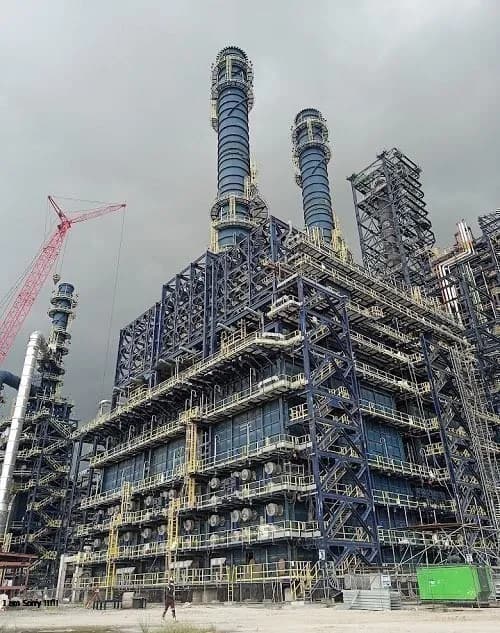
Nigeria’s domestic refining industry is preparing for a major shake-up in the downstream oil market as local refineries signal their readiness to significantly reduce petrol imports in 2026, following rising output from the Dangote Petroleum Refinery and modular plants across the country.
Industry operators say Nigeria now has sufficient installed refining capacity to meet national petrol demand, provided crude oil supply constraints are resolved and regulatory bottlenecks eased.
Domestic Capacity Rising, Imports Still Dominant
Data from the Nigerian Midstream and Downstream Petroleum Regulatory Authority (NMDPRA) shows that petrol imports accounted for 62.47 per cent of Nigeria’s total Premium Motor Spirit (PMS) consumption in 2025, despite the start-up and gradual ramp-up of the 650,000 barrels-per-day Dangote refinery.
Total national petrol consumption stood at 18.97 billion litres last year, with oil marketing companies importing 11.85 billion litres, while domestic refineries supplied about 7.54 billion litres, representing 37.53 per cent of consumption.
According to the Crude Oil Refiners Association of Nigeria (CORAN), this imbalance does not reflect the true refining potential within the country. The association insists that local plants, including Dangote, can collectively supply all Nigeria’s petrol needs if crude feedstock is made consistently available.
Feedstock Shortages Limit Refinery Output
Speaking on behalf of CORAN, its Publicity Secretary, Eche Idoko, said refinery underperformance is largely tied to inadequate crude oil supply rather than technical limitations.
He noted that while the Dangote refinery is currently producing about 50 million litres of PMS daily, some modular refineries are operating at less than 10 per cent of installed capacity, with others shutting down intermittently due to crude shortages.
“Installed capacity is not the issue. Feedstock availability has always been the challenge,” Idoko said, adding that several refineries are sourcing crude externally or operating below capacity due to unreliable supply arrangements.
He warned that uncertainty around crude access has also slowed financing for new refinery projects, as lenders demand assurances of long-term feedstock security before committing funds.
2026 Outlook: Imports Face Steeper Decline
Industry data already points to a gradual shift. Imported petrol volumes dropped from 52.1 million litres per day in November to 42.2 million litres per day in December, while Dangote refinery’s supply rose sharply from 19.5 million litres per day to 32 million litres per day within the same period.
The refinery has since commenced night-time loading operations, aiming to sustain daily deliveries exceeding 50 million litres nationwide. With peak national demand estimated at about 54 million litres per day, refiners argue that imports could become marginal if local output is fully optimised.
CORAN projects that domestically refined petroleum products could surpass imports in 2026, provided the government improves crude allocation, supports refinery financing, and adopts more accurate production tracking methods beyond truck-out data.
As Nigeria pushes toward energy self-sufficiency, the coming months may determine whether local refineries can finally displace petrol imports and stabilise fuel supply in Africa’s largest oil-producing nation.