

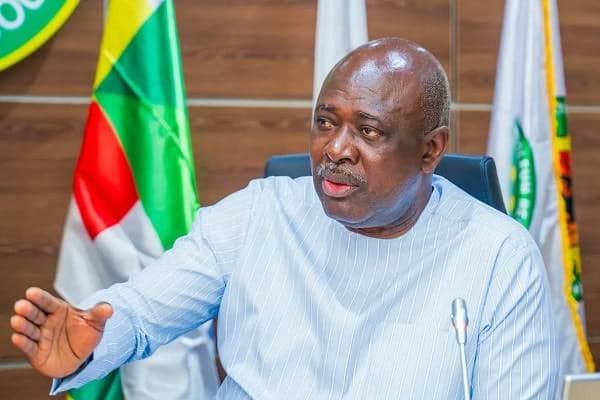
Minister of State for Petroleum Resources (Oil), Heineken Lokpobiri, has warned that a return to petrol subsidy would place additional pressure on Nigeria’s finances, questioning how the government would fund the policy without drawing resources from the oil sector.
Lokpobiri made the remarks during a breakfast meeting with media practitioners in Yenagoa, Bayelsa State, while responding to proposals by opposition presidential candidates to reinstate petrol subsidies if elected in 2027.
The minister specifically criticised the positions of African Democratic Congress (ADC) presidential candidate Atiku Abubakar and Nigeria Democratic Congress (NDC) presidential candidate Peter Obi, who have both expressed support for restoring the subsidy.
Atiku said in August that he would restore petrol subsidy if elected president in 2027, while Obi said on September 28 that his administration would bring back the policy after addressing corruption in the country.
Responding to the proposals, Lokpobiri asked where the money required to sustain the subsidy would come from, arguing that the funding would ultimately have to be sourced from the same oil sector that generates a significant share of Nigeria’s government revenue.
“Where would the money come from?” he asked.
“The money is expected to come from the same oil sector.”
According to Lokpobiri, maintaining artificially low petrol prices through government support had imposed a financial burden that Nigeria could no longer sustain. He argued that the decision to remove the subsidy was necessary to prevent the country from facing greater economic difficulties.
“The point I am trying to make is that if that decision was not made on subsidy removal, Nigeria would have been like Venezuela,” the minister said.
“God forbid, even Nigeria like Venezuela would not be able to gather here the way we are gathered today. Venezuelans queue even to buy bread. That is the level of poverty.”
Lokpobiri said the scale of the former subsidy burden was significant, noting that when President Bola Tinubu assumed office, the federal government was projected to spend about ₦18.4 billion daily on petrol subsidy payments.
He cited figures previously presented to the National Assembly by former Finance Minister Zainab Ahmed.
The minister also linked the former subsidy system to the financial difficulties experienced by the defunct Nigerian National Petroleum Corporation (NNPCL), arguing that the state oil company had struggled to generate sufficient financial strength while it remained heavily involved in the importation of refined petroleum products.
“You recall that NNPCL never paid any dividend. NNPCL never made any profit at all. What they were doing was shipping out crude and shipping in refined products. NNPCL was the sole importer of refined products,” he said.
Lokpobiri said the corporation’s financial difficulties were also reflected in its inability to meet cash call obligations associated with its participation in oil ventures.
He explained that a shareholder with a 60 percent interest in a business would ordinarily be responsible for 60 percent of the cost of running that business.
“If you say you own 60 per cent of a business, you also have to pay 60 per cent of the cost of doing that. That is the cash call,” he said.
“But before this government came, NNPCL couldn’t pay its cash call. Today, NNPCL is not owing any cash call.”
The minister said the financial position of the national oil company had changed following its transformation into NNPCL Limited, which operates under the Petroleum Industry Act.
Beyond the subsidy debate, Lokpobiri said Nigeria’s ability to increase crude oil production was being restricted by weaknesses in the country’s evacuation infrastructure.
He said Nigeria had the potential to produce between 2.5 million and 3 million barrels of crude oil per day, but inadequate infrastructure for moving crude from producing fields remained a major constraint.
“Our big challenge is that of evacuation. The pipelines today have all expired. They were used some 50 years ago, but the lifespan of those pipelines is gone,” he said.
According to the minister, thousands of wells that are currently shut in could potentially return to production through re-entry programmes. However, he cautioned that restoring production without addressing the condition of the pipeline network could simply shift the problem from production to evacuation.
He said the government and NNPCL were therefore working on a comprehensive programme to replace ageing pipelines through a public-private partnership arrangement.
Lokpobiri acknowledged that the pipeline replacement project would require time to complete but said its implementation would significantly expand Nigeria’s ability to move crude and support higher production.
“Once that is done, our capacity will rise astronomically,” he said.
The minister’s comments come as the debate over the future of petrol pricing remains a major issue ahead of the 2027 presidential election, with competing positions emerging over whether government intervention should return to the downstream petroleum market.
While proponents of subsidy restoration have argued that government support could reduce the burden of petrol prices on consumers, Lokpobiri maintained that the central question remains how such intervention would be financed without placing another substantial strain on public resources and the oil sector.