

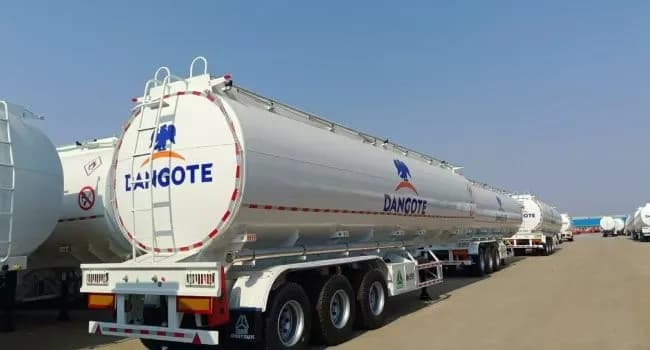
The Dangote Petroleum Refinery & Petrochemicals has commenced delivery of the first units in its 4,000-strong compressed natural gas (CNG) truck fleet, a ₦720 billion downstream logistics overhaul set to formally launch on August 15. The strategic initiative aims to slash fuel distribution costs, enhance last-mile delivery, and reshape Nigeria’s supply chain economics.
The first batch, received at the refinery’s Ibeju-Lekki site by Devakumar Edwin, Dangote Industries’ Vice-President for Oil and Gas, arrived via Apapa Port over the weekend. Group Chief Branding & Communication Officer Anthony Chiejina described the phased rollout as a “groundbreaking development in Nigeria’s fuel network”, despite prevailing global supply chain disruptions.
“This programme will significantly lower distribution costs and improve fuel availability nationwide,” Chiejina said, emphasising ongoing collaboration with regulators and industry stakeholders.
Dangote projects that within six weeks, 60 shiploads of the specialised CNG-powered trucks will be delivered, positioning the refinery to save Nigerians over ₦1.7 trillion annually in transportation costs. The plan also targets 42 million MSMEs, aiming to boost profitability, revitalise dormant filling stations, and create more than 15,000 direct logistics jobs.
Industry Reactions: Efficiency vs Monopoly Risk
The launch has polarised Nigeria’s downstream market operators. While some view the move as a catalyst for efficiency and competitive pricing, others warn of potential monopolisation, job losses, and systemic disruption.
For: The Independent Petroleum Marketers Association of Nigeria (IPMAN) praised the direct-to-market distribution model, arguing it will eliminate supply inconsistencies, cut transportation premiums, and narrow price disparities between coastal and inland markets.
IPMAN Rivers Chapter Chairman Tekena Ikpaki noted:
“Multi-source supply strengthens competition and stabilises pump prices. This is the type of public–private synergy the sector needs.”
Against: The Petroleum Products Retail Outlets Owners Association of Nigeria (PETROAN) condemned the move as a “monopoly in disguise,” cautioning that Dangote’s 650,000 bpd capacity should focus on global export competitiveness rather than controlling domestic distribution channels.
PETROAN President Billy Gillis-Harry warned that the introduction of 4,000 CNG trucks could sideline independent marketers, displace existing transporters, and force smaller filling stations to close.
Similarly, the Natural Oil and Gas Suppliers Association of Nigeria (NOGASA) urged Dangote to concentrate on refining, warning that bypassing traditional supply networks could mirror past operational failures seen with the NNPCL’s integrated logistics experiments.
“You can’t do it alone. Allow marketers to distribute. If you try to control the full chain, you risk collapsing the system,” said NOGASA President Benneth Korie.
Depot Operators Under Threat
The Depot and Petroleum Products Marketers Association of Nigeria (DAPMAN) faces structural risk from Dangote’s direct-delivery model, which would bypass depot storage and tank farm infrastructure entirely.
Removing storage fees, currently adding ₦40–₦100 per litre to pump prices, could benefit consumers but erode DAPMAN’s revenue base. An Apapa-based fuel trader, requesting anonymity, noted:
“The supply chain will get leaner, but depot owners and transport contractors will take the hit.”
Market Implications Ahead of August 15
From a market dynamics standpoint, Dangote’s move represents vertical integration on an unprecedented scale in Nigeria’s downstream sector. If executed efficiently, it could compress distribution margins, push pump prices lower in inland markets, and weaken the traditional depot–marketer–retailer model.
However, analysts caution that market concentration risk remains a concern. Without strong regulatory oversight from the Nigerian Midstream and Downstream Petroleum Regulatory Authority (NMDPRA), the initiative could gradually centralise control over supply flows in ways that weaken competition and erode independent market participation.
As the August 15 launch approaches, the sector remains sharply divided between those who see a cost-saving revolution and those who fear a monopolistic reordering of Nigeria’s fuel supply chain.