

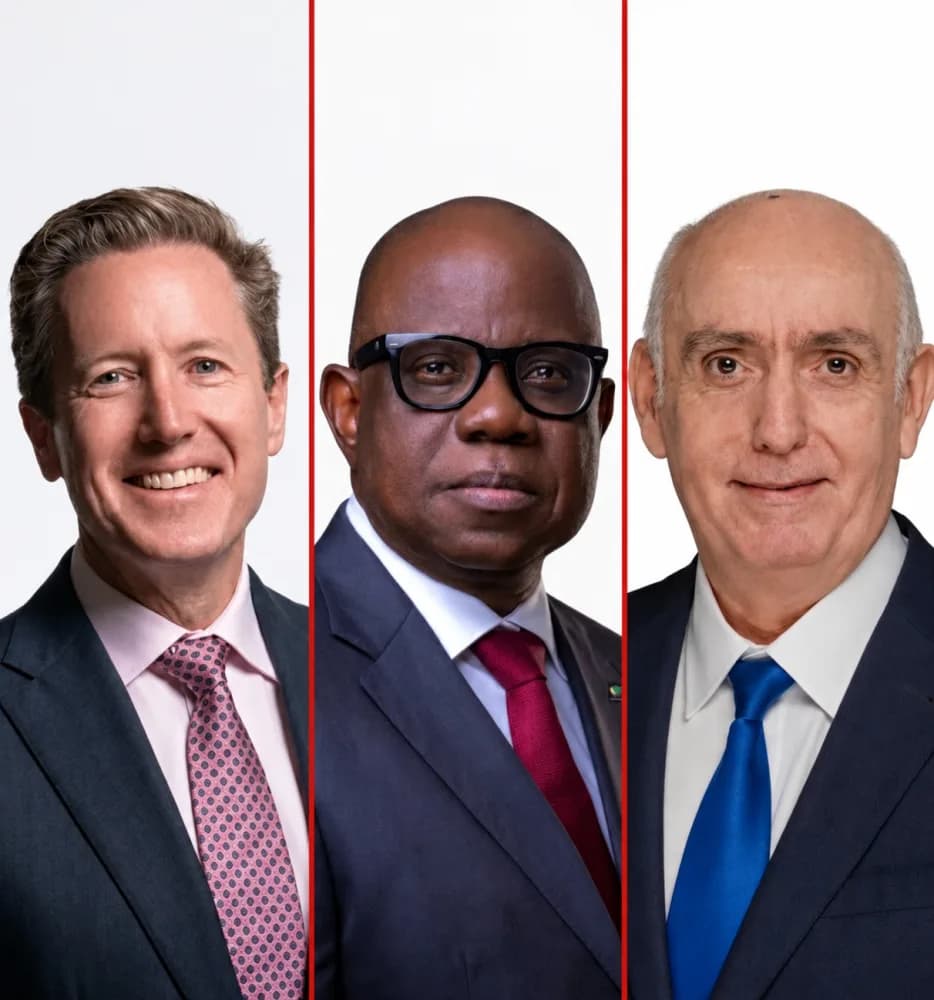
Nigeria sits at the heart of Africa's refining story in 2026. With the Dangote Petroleum Refinery now firmly established as the continent's largest single-train facility at 650,000 barrels per day, and the Nigerian National Petroleum Company Limited overseeing rehabilitation efforts at the Port Harcourt and Kaduna refineries, the country commands more downstream influence than any other nation on the continent.
Nigeria is not alone. Across North and Southern Africa, a class of seasoned energy executives is steering some of the most strategically significant refining assets on the continent, facilities that collectively determine how much of Africa's crude is processed at home rather than exported raw and reimported as finished fuel.
Here are the seven chief executives running Africa's largest refineries in 2026, ranked by refinery capacity, according to Nairametrics.
7. NOUREDDINE DAOUDI, SKIKDA REFINERY, ALGERIA
Capacity: 122,000 barrels per day
Nour Eddine Daoudi chairs and leads Sonatrach, Algeria's state-owned energy giant and one of Africa's most influential oil and gas corporations. He was appointed to the role in October 2025, marking the culmination of a career spanning more than three decades in Algeria's hydrocarbons sector.
Daoudi studied geology at the Houari Boumediene University of Science and Technology in Algiers, graduating in 1987, and then joined Sonatrach a year later. He rose through the exploration division before being named Director of Exploration in 2018, a role that placed him at the centre of Algeria's efforts to strengthen its upstream resource base. In April 2020, he was appointed chairman of Algeria's upstream licensing regulator, ALNAFT, where he led governance reforms aimed at attracting international investment. Since January 2022, he has also served on the Executive Board of the International Energy Forum.
Among Sonatrach's downstream assets is the Skikda Condensate Refinery II, located on Algeria's Mediterranean coastline and commissioned in 1980. The facility processes approximately 122,000 barrels per day, forming part of Algeria's broader refining and petrochemical network that supplies both domestic and export markets.
6. RASHAD NAZIM HASSAN, EL NASR REFINERY, EGYPT
Capacity: 131,000 barrels per day
Engineer Rashad Nazim Hassan Mohamed serves as Chairman and Managing Director of Nasr Petroleum Company, the operator of the El Nasr Petroleum Refinery located in Suez. His appointment was part of a deliberate leadership reshuffle within Egypt's petroleum sector, aimed at improving operational efficiency and modernisation across the industry.
Hassan graduated from Suez Canal University with a bachelor's degree in engineering in 1994 and joined Nasr Petroleum the following year. He spent nearly three decades advancing through technical and managerial roles within the company, building a reputation for driving operational improvements. In 2012, he became Assistant General Manager for Development and Improvement. By 2017, he had risen to General Manager for Technology and Development and joined the company's Board of Directors.
The El Nasr refinery traces its origins to 1911 when it operated under Shell, before being nationalised in 1964 under the Egyptian General Petroleum Corporation. Today, the facility processes an estimated 131,000 barrels per day, producing gasoline, diesel, kerosene, fuel oil and lubricants for Egypt's domestic market.
5. DR MOHAMED SAAD IBRAHIM, MOSTOROD REFINERY (ERC), EGYPT
Capacity: 161,000 barrels per day
Mohamed Saad Ibrahim serves as Managing Director of the Egyptian Refining Company, the entity behind Egypt's most ambitious downstream redevelopment project. He is one of the most experienced petroleum executives in the country, with a career spanning more than five decades in the industry.
Ibrahim began his career in 1975 as an engineer at Nasr Petroleum before moving to Suez Petroleum Company in 1977. He held successive technical and executive positions over the following decades, eventually rising to Chairman of Suez Petroleum. In 2009, he became Chairman of Al Nasr Petroleum Company, and later served as Vice Chairman of South Valley Egyptian Petroleum Holding Company until 2012. He also holds academic appointments as Professor Emeritus at the Faculties of Petroleum and Mining Engineering and Science in Ismailia.
His academic credentials include a bachelor's degree in engineering from Suez Canal University in 1975, a master's degree in Chemical Engineering from the University of Oklahoma in 1985, and a doctorate in Chemical Engineering from Cairo University in 1995.
The Mostorod refinery, first commissioned in 1973, was redeveloped through a 4.3 billion dollar investment led by the Egyptian Refining Company in partnership with the Cairo Oil Refining Company. The upgraded facility now processes between 142,000 and 161,000 barrels per day, with a focus on converting heavy fuel oil into Euro V diesel and jet fuel.
4. BASHIR BAYO OJULARI, PORT HARCOURT AND KADUNA REFINERIES, NIGERIA
Combined Capacity: 210,000 barrels per day
As Group Chief Executive Officer of NNPC Limited, Bashir Bayo Ojulari carries ultimate responsibility for Nigeria's state-owned refining assets, including the Port Harcourt Refining Company and the Kaduna Refining and Petrochemical Company, as both facilities undergo extensive rehabilitation programmes. President Bola Ahmed Tinubu appointed him to the role on 2 April 2025.
Ojulari is a petroleum engineer with more than three decades of international experience. He graduated from Ahmadu Bello University, Zaria with a degree in Mechanical Engineering in 1989 and began his career that same year as a field and process engineer at Elf Petroleum Nigeria. He joined Shell in 1991, building a career across Nigeria, Europe and the Middle East that included roles as Head of Planning, Economics and Budgeting at Shell Petroleum Development Company, Asset Leader in Oman, and Regional Planner for Sub-Saharan Africa.
In 2015, he was appointed Managing Director of Shell Nigeria Exploration and Production Company and General Manager, Deepwater, where he played a key role in advancing Nigeria's deepwater operations including the Bonga field. After retiring from Shell in 2021, he founded BAT Advisory and Energy before joining Renaissance Africa Energy Company in 2024 as Executive Vice President and Chief Operating Officer, helping lead the consortium that acquired Shell's onshore Nigeria business for 2.4 billion dollars.
The Port Harcourt refinery, Nigeria's largest, has a nameplate capacity of 210,000 barrels per day. Together with the Kaduna facility, it forms the core of NNPC's downstream rehabilitation agenda.
3. MASOUD MAHMOUD SULEMAN, RAS LANUF REFINERY, LIBYA
Capacity: 220,000 barrels per day
Masoud Mahmoud Suleman chairs the National Oil Corporation of Libya, which wholly owns and oversees the Ras Lanuf Refinery, the largest refining facility in the country. His career within Libya's petroleum industry spans more than 22 years.
Before he was appointed Chairman, Suleman served as Deputy Chairman of the National Oil Corporation and led the organisation through several critical periods between 2022 and 2024. He also chaired the Management Committee of Mellitah Oil and Gas, the joint venture between NOC and Italian energy major ENI, where he advanced strategic cooperation and project development. Earlier in his career, he worked as Superintendent of Reservoir Engineering at Sirte Oil Company, gaining expertise in reservoir management and field development.
Built in 1984 during Libya's oil expansion era, the Ras Lanuf refinery was designed as an export-oriented complex integrated with petrochemical production. Located in the coastal town of Ras Lanuf along the Gulf of Sidra, the facility has a nameplate capacity of 220,000 barrels per day and remains a critical component of Libya's downstream and export infrastructure.
2. SIMON BALOYI, SASOL REFINERY, SOUTH AFRICA
Capacity: 250,000 to 300,000 barrels per day
Simon Baloyi became President and Chief Executive Officer of Sasol Limited in April 2024, assuming leadership of one of Africa's most distinctive energy companies and its complex dual refining system. He joined Sasol in 2002 and rose entirely through the company's internal ranks.
Earlier in his career, Baloyi worked in process engineering and research, spanning Fischer Tropsch technology development and plant optimisation. He subsequently held senior leadership roles across regional operations, asset services and engineering. He holds advanced engineering and management qualifications from the University of Pretoria and completed executive education at INSEAD. He also serves as Co-Chair of the B20 Energy Mix and Just Transition Task Force, contributing to global policy discussions on inclusive energy transition.
Sasol operates a dual refining system that combines conventional crude processing at the Natref refinery in Sasolburg, in which it holds a 63.64 per cent stake and which has a capacity of approximately 108,000 barrels per day, with a proprietary coal-to-liquids process at its Secunda facility. Together, the two plants give Sasol a combined liquid fuel output capacity of over 250,000 barrels per day, making it Africa's second-largest refining operation by output.
1. DAVID BIRD, DANGOTE PETROLEUM REFINERY, NIGERIA
Capacity: 650,000 barrels per day
David Bird is the Chief Executive Officer and Managing Director of Dangote Petroleum Refinery and Petrochemicals, the largest single-train refinery in Africa and one of the most significant downstream investments anywhere in the world. He assumed the role in 2025, tasked with scaling output, deepening export market reach, and positioning Nigeria as a credible supplier of refined petroleum products on the global stage.
Bird brings more than 25 years of international experience across oil, gas, refining and petrochemicals. Before joining Dangote, he served as Chief Executive Officer of OQ8 in Oman, a major downstream joint venture between Oman Oil Company and Kuwait Petroleum International, where he led project delivery, financial restructuring and operations transformation. Prior to that, he was Senior Vice President for Production Operations and Supply Chain at Santos Ltd in Australia.
He spent more than a decade at Shell in senior downstream roles, including refinery plant manager in South Africa, head of supply for Asia Pacific and the Middle East, and Vice President of Prelude FLNG in Australia. He began his career in engineering at Hitachi in Japan. He holds an MBA from Stanford Graduate School of Business and completed executive education at INSEAD.
Located within the Lekki Free Trade Zone in Lagos and spanning approximately 2,635 hectares, the Dangote refinery has a processing capacity of 650,000 barrels per day. It is designed to meet Nigeria's domestic fuel demand while generating surplus volumes for export, reducing the country's long-standing dependence on imported petroleum products.