

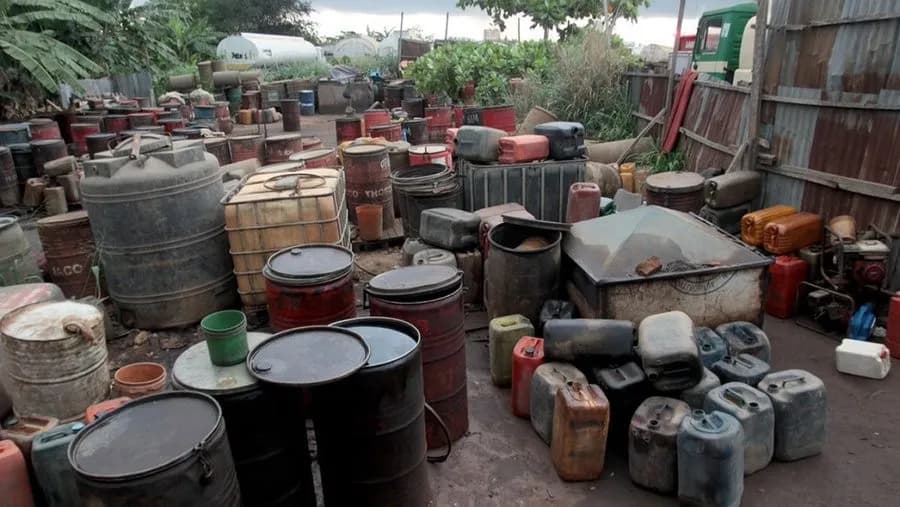
The Nigerian military has raised concerns over a new and more dangerous tactic adopted by crude oil thieves in the Niger Delta, revealing that criminal networks now use chemical mixtures to process stolen crude into adulterated petroleum products.
Security officials say the shift reflects growing sophistication among illegal refiners as sustained military operations intensify pressure on crude theft, pipeline vandalism, and illicit refining activities across the region.
The Commander of Operation Delta Safe, Rear Admiral Olugbenga Oladipo, disclosed the development during an operational engagement with journalists, stressing that criminal elements have continued to adapt rather than abandon illegal activities or embrace lawful means of livelihood.
According to Oladipo, illegal refiners have largely stopped openly burning crude oil—a method that previously exposed them to rapid detection—and instead rely on chemicals to process crude into substandard fuel products.
“Illegal refiners are evolving. They no longer burn crude openly. They now use chemicals to mix with crude oil to produce adulterated petroleum products,” he said.
He warned that the process is technically incomplete and highly destructive, noting that such products damage vehicle engines, generators, and the environment. Oladipo added that security forces are adjusting operational strategies to counter the trend, including monitoring the supply chains used to source the chemicals.
Military Expands Intelligence and Community Engagement
The naval officer emphasised the importance of public cooperation, describing intelligence gathering as a shared responsibility, since Nigeria’s crude oil resources belong to all citizens.
He urged communities to report suspicious movements, including trucks accessing creek areas or unfamiliar individuals operating around oil facilities.
“We must strengthen a ‘see something, say something’ culture. The media has a key role in reinforcing this message,” Oladipo said.
Beyond illegal refining, he identified crude oil theft at wellheads as another persistent challenge. He explained that many installations are located in remote areas with thick vegetation, making access difficult even after criminal activity is detected.
“In many locations, terrain and vegetation severely limit movement. Still, we conduct at least two major operations daily, alongside routine patrols,” he said.
Despite the challenges, Oladipo maintained that the military remains focused on protecting national oil output. He noted that recent production constraints stem mainly from maintenance activities and seasonal factors, rather than widespread vandalism.
Security Collaboration and Technology Gaps
Reassuring investors and industry stakeholders, Oladipo described the Niger Delta as a safe environment for business, citing increased exploration activities and renewed interest from oil and gas companies as signs of improving confidence.
He dismissed reports of rivalry among security agencies, stressing that collaboration across the Armed Forces and other agencies remains strong.
“All agencies are working together toward a single objective: securing national assets and supporting increased production,” he said.
On capacity, Oladipo noted that personnel training was not a limiting factor, as troops receive both local and international training. However, he emphasized the urgent need for improved infrastructure and advanced surveillance technology to counter the increasingly sophisticated methods of criminals.
“These technologies are costly, but they are essential for effective maritime and energy security,” he said, while appealing to the media to help educate communities on their role in protecting national assets.
Earlier, the Director of Defence Media Operations, Major General Michael Onoja, said the Chief of Defence Staff, General Olufemi Oluyode, is coordinating multiple security operations nationwide, with a renewed focus on information management.
Onoja described Information Operations as a core element of modern military strategy, noting that insufficient emphasis in the past affected public perception of both the Armed Forces and government efforts.
He added that the military now prioritises two-way engagement with civilians, where citizens provide actionable information and security forces respond decisively.
“The Nigerian media remains a critical partner in building trust and cooperation between the Armed Forces and the public,” Onoja said.
He commended the sacrifices of troops and other security agencies, including the Nigeria Police Force, and stressed that national security requires a collective, whole-of-nation approach.
“The military cannot do it alone. Every citizen has a role in strengthening Nigeria’s security architecture,” he said.