

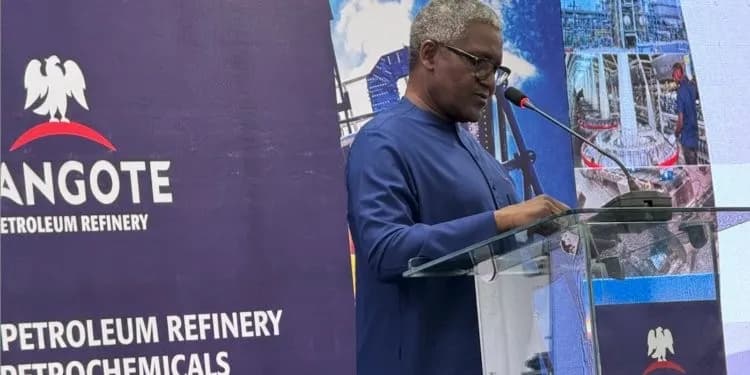
The naira may be heading for a major rebound in 2026 but only if Nigeria gets serious about cutting imports. Africa’s richest industrialist, Aliko Dangote, says the currency could strengthen sharply and even trade at ₦1,100 to the dollar next year if the Federal Government blocks avoidable importation and backs local production.
Dangote spoke in Abuja during the launch of the Nigeria Industrial Policy, where he tied exchange rate stability directly to domestic manufacturing and foreign exchange conservation. With the naira currently trading above ₦1,300 at the official market, his projection has sparked fresh debate across financial and policy circles.
Import Controls and Exchange Rate Pressure
Dangote did not mince words. “Today, the dollar is ₦1,340… with what I know, by blocking all this importation, the currency this year will be as low as ₦1,100 if we are lucky,” he said. He went further to argue that sustained import substitution could push the naira even closer to ₦1,100/$1 in 2026.
According to him, Nigeria’s biggest problem is structural. “We are an import-based country, which we shouldn’t be. What we should be doing is manufacturing all the things that we need,” he stated. In practical terms, reducing import bills lowers demand for dollars, strengthens the current account position and eases pressure on the foreign exchange market.
However, he described the situation as a “catch-22”. While a stronger naira would reduce inflation and lower production costs, it could also shrink government earnings in naira terms from oil exports. Nevertheless, Dangote insisted that protecting local industry remains the sustainable path to currency stability.
Refinery Capacity and FX Conservation
A major part of Dangote’s confidence stems from the operational scale of the Dangote Petroleum Refinery. With a nameplate capacity of 650,000 barrels per day, the refinery is expected to reduce fuel importation drastically historically one of Nigeria’s largest sources of FX demand.
Similarly, investor Femi Otedola has projected that the naira could trade below ₦1,100/$1 once refining operations reach full capacity and conserve billions in foreign exchange. If domestic supply replaces imports consistently, the FX market could gradually rebalance.
Ultimately, whether the naira could hit ₦1,100/$1 in 2026 will depend on policy discipline. If the Federal Government blocks unnecessary imports, strengthens power supply and protects manufacturers, investor confidence could deepen and capital inflows may rise. But if reforms weaken, the structural FX pressure could return. For now, Dangote’s projection sets a clear benchmark one that puts industrialisation at the centre of Nigeria’s currency recovery strategy.