

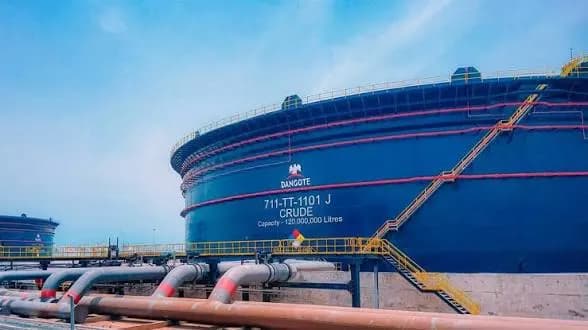
Nigeria exported 55.39 million barrels of crude oil in the first two months of 2026, even as the Dangote Petroleum Refinery continues to struggle with inadequate domestic crude supply, widening concerns over the balance between exports and local refining.
Data from the Central Bank of Nigeria (CBN) showed that 31.31 million barrels were exported in January and 24.08 million barrels in February. Production stood at 1.46 million barrels per day in January, with exports at 1.01 mbpd, while February output dropped to 1.31 mbpd with exports averaging 0.86 mbpd. Overall, total crude production for the two months hit 81.94 million barrels, leaving about 26.55 million barrels for domestic use.
Despite Nigeria’s status as Africa’s top crude producer, the figures highlight the continued strain on domestic refining capacity, particularly for the 650,000 barrels-per-day Dangote Refinery. The facility has repeatedly complained about insufficient local crude allocations, forcing it to rely on imports to sustain operations.
According to Punch, between October 2025 and mid-March 2026, the refinery reportedly faced a crude shortfall of about 79.53 million barrels, receiving far below its estimated monthly requirement of 19.77 million barrels.
Actual supply during the period remained inconsistent, with deliveries falling significantly short of operational needs.
The imbalance persists despite the naira-for-crude arrangement aimed at boosting local supply. Industry stakeholders argue that crude exports continue to take priority, while domestic refiners struggle with feedstock shortages that limit production stability.
The refinery has also had to adjust fuel prices multiple times due to rising costs, with petrol previously climbing above ₦1,300 per litre before easing to about ₦1,250 per litre, reflecting pressure from crude sourcing costs and market volatility.
The Dangote Refinery maintains that it receives fewer cargoes than required from the national oil company, averaging about five cargoes monthly instead of the estimated 13 needed for full capacity operations. This gap has increased reliance on international traders, raising overall production costs.
Analysts say the situation underscores a deeper structural issue in Nigeria’s downstream sector, where export earnings remain strong while local refining continues to face feedstock constraints, limiting the country’s ability to fully benefit from its crude production.