

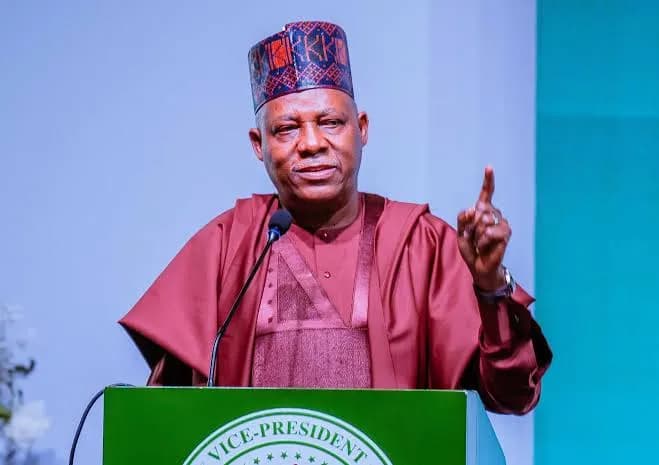
Vice President Kashim Shettima on Monday declared that Nigeria’s national interest must outweigh union disputes, stressing that the 650,000-barrel-per-day Dangote Refinery is too critical to the nation’s economy to be undermined.
Speaking at the opening of the 2025 Nigerian Economic Summit (NES31) in Abuja, themed “The Reform Imperative: Building a Prosperous and Inclusive Nigeria by 2030,” Shettima described the $20 billion facility as a national asset that deserves unwavering support from both government and citizens.
He said, “The Dangote Refinery must be protected at all costs. Aliko Dangote is not just an individual; he’s an institution and a leading light in Nigeria’s economic landscape. How we treat him will shape how the world perceives our commitment to private investment. If he had invested $10 billion in Microsoft, Amazon, or Google, he might be worth $70 to $80 billion today. But he chose to invest in his country, and we owe it to future generations to protect and promote that choice.”
Shettima Cautions Labour, Calls for Patriotism
Shettima’s remarks came in response to last week’s industrial action by the Petroleum and Natural Gas Senior Staff Association of Nigeria (PENGASSAN) over disputes with the refinery. He urged labour unions to act with caution, introspection, and patriotism in their engagements with employers, warning against actions capable of destabilising the economy.
“It’s not about holding the entire country to ransom over a minor labour dispute,” he said. “Nigeria is greater than PENGASSAN and greater than any one of us. I’m not speaking as a partisan; I’m speaking as a patriot who believes in the stability of our nation.”
Minister of Budget and National Planning, Senator Atiku Bagudu, echoed Shettima’s position, describing the refinery as a cornerstone of Nigeria’s industrial future and a vital driver of energy security.
Investors Urge Policy Stability and Trust
Olaniyi Yusuf, Chairman of the Nigerian Economic Summit Group (NESG), also addressed the gathering. He noted that the way Nigeria treats its domestic investors sends powerful signals to foreign investors assessing the country’s business climate.
“The treatment of local investors determines how the world views us,” Yusuf said. “Policy predictability, investment protection, and transparent mechanisms for resolving disputes are key to rebuilding confidence in the economy.”
He added that although Nigeria’s fiscal condition has shown slight improvement, the country still faces high inflation, heavy debt-service burdens, and weak investor sentiment, stressing the need for credible reforms and policy continuity.