
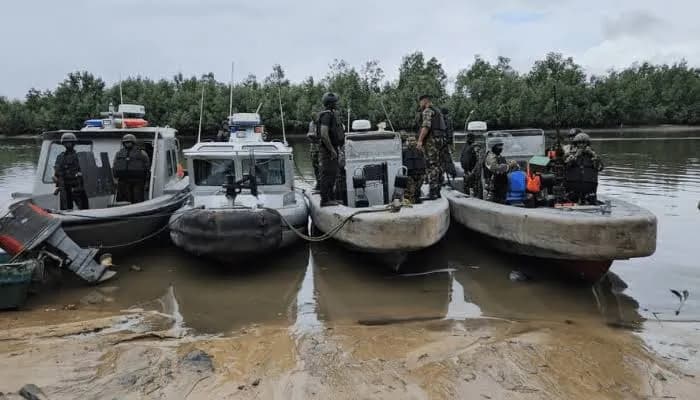
The Nigerian Navy has raised concerns over the activities of certain unpatriotic individuals allegedly engaged in acts of economic sabotage, including crude oil theft. According to Rear Admiral Eugenio Olusegun Ferriera, Chief of Training and Operations, these elements have resorted to spreading false allegations to disrupt legitimate international transactions, causing significant revenue losses for the federal government.
At a briefing on Monday, Rear Admiral Ferriera highlighted the Navy’s commitment to combating crude oil theft. He revealed that false claims between May 4 and May 16, 2024, led to the disruption of operations involving MT Prestigious and MT Montagu, resulting in the loss of over 1.2 million barrels of crude oil.
False Alarms and Economic Implications
Rear Admiral Ferriera cited examples of false allegations, such as accusations against MT Praisel in August 2023 and MT Lady Martina in November 2024. Despite claims of oil theft, the Navy’s investigations, including product testing, confirmed compliance with regulatory standards.
“These false accusations were not backed by evidence but were designed to tarnish the Navy’s image and disrupt legitimate oil operations,” Ferriera said. He emphasized that such acts undermine the ease of doing business in Nigeria’s oil sector, discouraging investment and impacting national revenue.
Achievements in the Fight Against Oil Theft
The Nigerian Navy has made significant strides in tackling oil theft over the past four years. According to Ferriera:
Over 8.1 million barrels of stolen crude oil, 86,500 metric tons of illegally refined AGO, 788,312 liters of PMS, and 21 million liters of kerosene have been confiscated.
120 barges, 181 speed boats, 1,453 wooden boats, and 118 vehicles laden with stolen products have been seized.
392 suspects were apprehended, with many handed over to law enforcement agencies for prosecution.
Additionally, the Navy deactivated over 1,528 illegal refining sites and 8,790 storage tanks used for oil theft.
Ferriera also highlighted international collaborations with neighboring countries like Cameroon, Benin, and Togo. These partnerships facilitated arrests of vessels such as MT New Angel and MT Jasmine, further curbing transnational oil theft.
Regional and Strategic Efforts
In November 2024, the Navy hosted multinational exercises Crocodile Lift and Grand African NEMO, involving ships from Nigeria, France, the UK, and Spain. These exercises aimed to enhance maritime security and counter maritime crimes in the Gulf of Guinea.
The Navy’s robust measures, including intelligence-led patrols and the Choke Point Management and Control regime, have also increased Nigeria’s daily crude oil production from 1.23 million barrels in 2022 to 1.8 million barrels in 2024, as reported by the NUPRC.
Promoting Transparency and Accountability
Rear Admiral Ferriera assured the public of the Navy’s collaboration with regulators such as NUPRC, NIMASA, and NNPCL to ensure compliance with approved operations. He reiterated the Navy’s zero-tolerance policy for internal misconduct, with strict disciplinary measures in place for errant personnel.
“Despite challenges, the Navy remains committed to safeguarding Nigeria’s oil resources, ensuring economic prosperity, and honoring the sacrifices of its personnel,” Ferriera concluded.
Admiralty University of Nigeria Celebrates 3rd Convocation
In a related event, the Admiralty University of Nigeria (ADUN) marked its 3rd convocation at the Ibusa campus in Delta State on November 22, 2024. The ceremony, attended by dignitaries from academia and the military, celebrated 100 graduating students, with seven achieving first-class honors.
Rear Admiral Ibrahim Dewu, representing the Chief of Naval Staff, Vice Admiral Emmanuel Ogalla, highlighted ADUN’s progress and affordable tuition fees. Established in 2017, the university currently offers programs across three faculties: Arts, Management and Social Sciences; Sciences; and Law. A new Faculty of Engineering is under development.
This dual commitment by the Navy—to maritime security and education—reflects its broader mandate of fostering national development.