

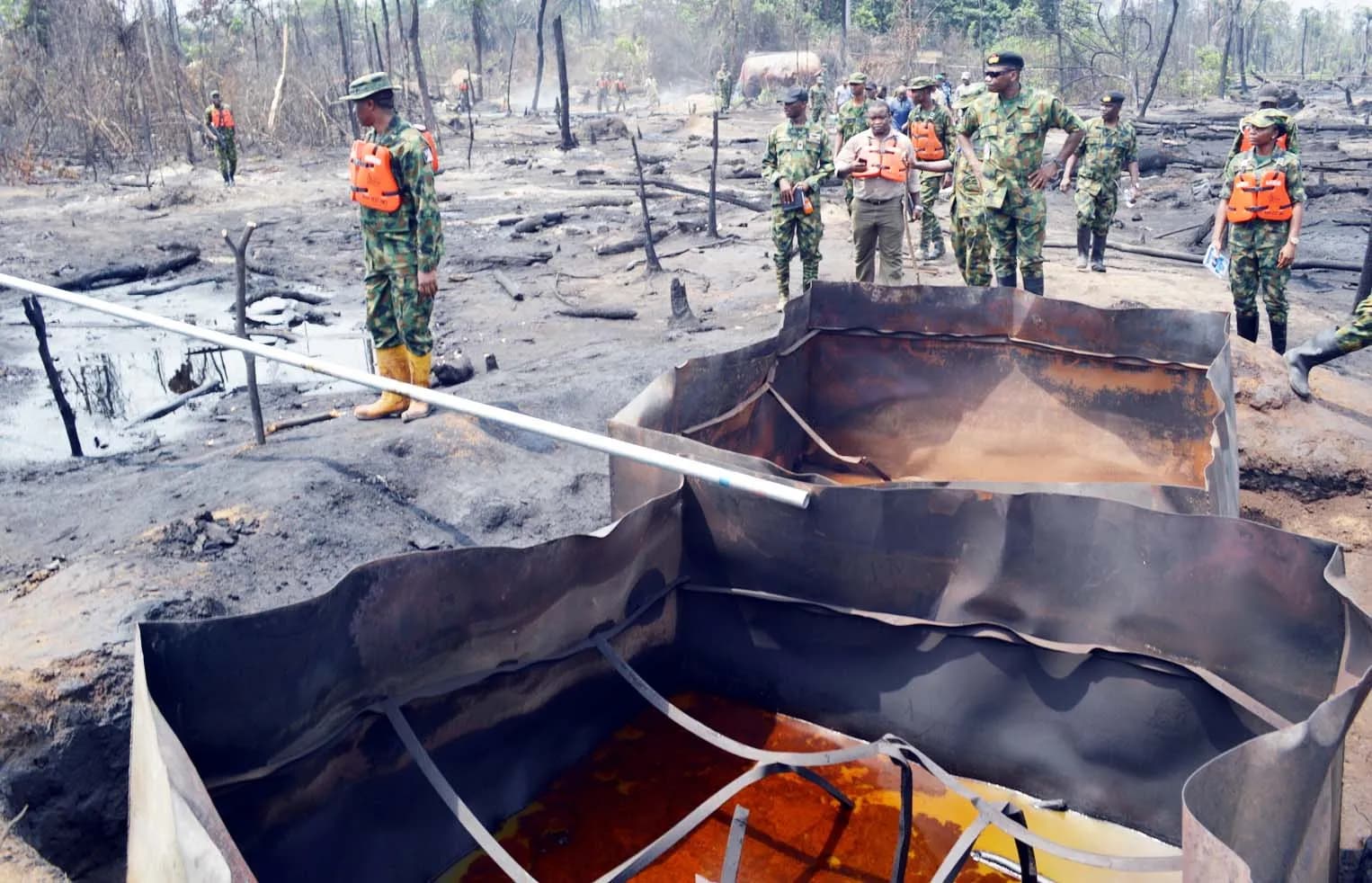
The Nigerian Navy has dismantled 71 illegal refineries and seized over 400,000 litres of stolen crude oil in the Niger Delta during July 2025, in one of its largest crackdowns this year.
Operation Delta Sanity Targets Oil Theft
Commodore Ayiwuyor Adams-Aliu, Director of Naval Information, said naval forces executed the operation under Operation Delta Sanity, a maritime security campaign targeting crude oil theft, illegal refining, and other economic crimes in Nigeria’s oil-producing region.
Destruction of Sites and Seizures
The raids covered Rivers, Delta, Bayelsa, and Akwa Ibom states, where security teams destroyed 120 illegal storage pits and confiscated equipment used in processing stolen crude.
From the seizures, the Navy recovered about 411,400 litres of crude oil, 87,825 litres of illegally refined diesel (Automotive Gas Oil), 72,000 litres of kerosene (Dual Purpose Kerosene), and 21,900 litres of petrol (Premium Motor Spirit).
Key Operations in July
On 4 July, refining sites in Ogba, Egbema, and Ndoni (Rivers State) were shut down, with 66,000 litres of crude and 40,000 litres of diesel intercepted. On 14 July, raids in Akwa Ibom and Delta disrupted smuggling runs to Cameroon, uncovering hidden reservoirs. Later, on 22–23 July, two large-scale sites in Bayelsa’s Biseni Community yielded over 450,000 litres of crude.
Arrests and Smuggling Interceptions
Several wooden boats used for smuggling fuel were seized, and six suspects were arrested.
Boosting National Oil Output
Adams-Aliu said the Navy’s efforts are boosting Nigeria’s oil output, now above 1.8 million barrels per day, as confirmed by the Nigerian Upstream Petroleum Regulatory Commission.
Long-term Impact on Oil Theft
The move follows a Nigerian Extractive Industries Transparency Initiative report showing oil theft losses of ₦16.25 trillion between 2009 and 2020. However, theft dropped from 36.69 million barrels in 2022 to 7.68 million barrels in 2023, reflecting improved security.
Economic and Environmental Significance
Analysts note that curbing illegal refining protects national revenue; furthermore, it prevents severe environmental damage from oil spills and artisanal refining waste. Consequently, this addresses long-standing issues in Niger Delta communities.