

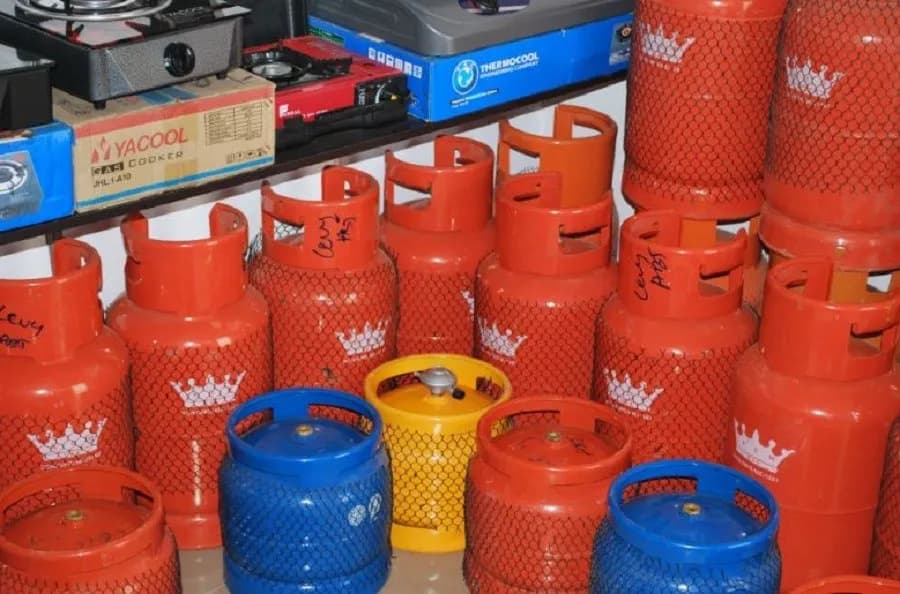
Nigeria’s domestic supply of Liquefied Petroleum Gas (LPG), commonly known as cooking gas, climbed to an average of 5,201 metric tonnes per day (mt/d) in December 2025, marking the highest monthly level ever recorded.
Data from the Nigerian Midstream and Downstream Petroleum Regulatory Authority (NMDPRA) show that stronger logistics performance and elevated festive-season demand drove the increase.
Domestic producers accounted for the bulk of the supply during the month. Operators, including Nigeria LNG (NLNG), Dangote Refinery, and other gas processing plants, supplied a combined 3.7 thousand mt/d, representing about 71 percent of total market volumes.
Despite the strong showing, domestic output fell below earlier 2025 highs. Production peaked at 4.5 thousand mt/d in July and 4.4 thousand mt/d in August before easing toward year-end.
Importers supplied the remaining 1.5 thousand mt/d, accounting for approximately 29 percent of the total LPG supply in December. This level was slightly lower than 1.6 thousand mt/d recorded in November, reinforcing the gradual decline in Nigeria’s reliance on imported cooking gas.
Average daily LPG consumption stood at 4,380 metric tonnes per day during the month, reflecting sustained household demand. Retail prices ranged between ₦1,120 and ₦1,600 per kilogram, depending on location and distribution costs.
Upstream and Infrastructure Performance
Upstream gas facilities recorded solid utilisation levels during the period. NLNG Trains 1–6, with a combined design capacity of 3.5 billion standard cubic feet per day (Bscf/d), operated at an 82.67 percent utilization rate.
The Gbaran-Ubie Gas Plant, with a capacity of 1.259 Bscf/d, achieved 86.36 percent utilisation. Additional contributions came from MPNU BRT at 0.690 Bscf/d, the Escravos Gas Plant at 38.71 percent utilization, the Soku Gas Plant at 0.600 Bscf/d and 105.69 percent utilization, and the Obite Gas Plant at 0.554 Bscf/d with 53.15 percent utilization.
Market Implications
The December supply record highlights Nigeria’s expanding domestic LPG capacity and the steady shift away from imports. Regulators say sustained infrastructure reliability, efficient distribution, and stable upstream performance will remain critical to maintaining supply growth and supporting price stability into 2026.