

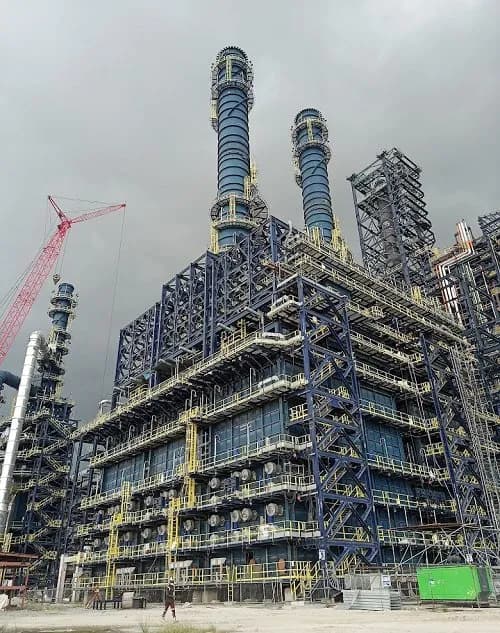
Nigeria’s local refining capacity has climbed to its strongest level in at least three years, rising to about 37–40 per cent of national petrol consumption in 2025, according to an analysis of regulatory data by The PUNCH.
The development marks a notable improvement from 2022, when Nigeria relied on fuel imports for nearly 70 to 100 per cent of its Premium Motor Spirit (PMS) needs, underscoring the gradual structural shift underway in the downstream petroleum sector.
Figures from the Nigerian Midstream and Downstream Petroleum Regulatory Authority (NMDPRA) show that total petrol consumption stood at 18.97 billion litres in 2025. Domestic refineries supplied about 7.54 billion litres, while imports accounted for 11.85 billion litres, or 62.47 per cent of total demand.
Three-year rise in Nigeria local refining capacity
The steady rise in Nigeria local refining reflects the combined impact of new private capacity, particularly the 650,000-barrel-per-day Dangote Petroleum Refinery, alongside output from modular refineries and limited production from rehabilitated state-owned plants.
In 2022 and 2023, effective domestic PMS supply was minimal, leaving Nigeria almost entirely dependent on imported petrol. By 2025, however, regulatory data show that local refineries now consistently contribute between 30 and 40 per cent of national demand — the highest level recorded in decades.
Energy analysts describe the shift as significant, noting that Nigeria has moved from near-total import dependence to a more balanced supply structure within a short period.
Imports still dominate despite refining gains
Despite the surge in Nigeria local refining, petrol imports remained the dominant source of supply throughout 2025. Monthly data show that import volumes exceeded domestic output in most months, particularly during periods of heightened demand.
In May 2025, for instance, imports reached 1.20 billion litres, accounting for about 71 per cent of monthly consumption, while local refineries supplied 573.5 million litres. The gap narrowed significantly in December, when domestic supply rose sharply to 992 million litres, its strongest monthly performance of the year.
Overall petrol consumption fluctuated widely, rising from 1.60 billion litres in January to 1.97 billion litres in December, driven by seasonal demand, logistics dynamics, and pricing conditions following deregulation.
Dangote refinery drives local supply growth
A breakdown of the NMDPRA factsheet shows that the Dangote Petroleum Refinery accounted for virtually all domestic PMS supply in 2025, delivering between 17 million and 32 million litres per day, depending on the month.
The refinery supplied a total of 7.54 billion litres during the year, marginally below its regulatory benchmark but sufficient to push Nigeria local refining to a three-year high. Output accelerated towards the end of the year, with December recording the highest daily average domestic supply.
Dangote officials maintain that the refinery has the capacity to meet Nigeria’s petrol demand and significantly reduce foreign exchange pressure linked to fuel imports.
Reduced import dependence, not full self-sufficiency
Industry experts caution that while Nigeria local refining has expanded rapidly, the country has not yet achieved petrol self-sufficiency. Imports continue to play a stabilising role, serving as a buffer against refinery downtime, logistics disruptions, and demand spikes.
Analysts stress that Nigeria’s downstream market remains anchored to import-parity pricing, where the option to import continues to shape supply security and price stability.
As a result, the more accurate policy narrative, experts say, is reduced marginal import dependence, rather than the elimination of imports — a distinction considered critical for maintaining credibility in Nigeria’s post-subsidy energy market.