

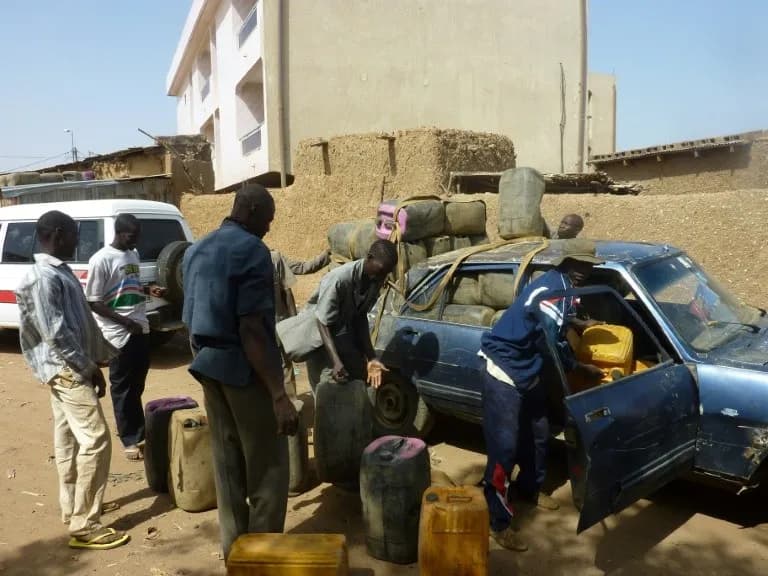
Despite Nigeria’s landmark removal of fuel subsidies in 2023, petrol smuggling across its porous borders remains rampant, driven not by subsidized domestic prices but by stark price disparities with neighboring West African countries.
On May 12, 2025, the average retail price of petrol in Nigeria stood at $0.541 per liter, which equals ₦861.25 (using the official exchange rate). This remains one of the lowest pump prices across the West African sub-region, even after the elimination of government subsidies. In contrast, bordering nations like Benin, Cameroon, and Niger continue to record much higher retail prices, making smuggling a highly lucrative underground business.
Cross-Border Price Comparison (As of May 12, 2025)
| Country | Price (USD/L) | Price (₦/L) | Difference from Nigeria (₦) | % Higher Than Nigeria |
|---|---|---|---|---|
| Nigeria | $0.541 | ₦861.25 | – | – |
| Benin | $1.104 | ₦1,228.29 | ₦367.04 | +43% |
| Cameroon | $1.084 | ₦1,212.41 | ₦351.16 | +41% |
| Niger | $1.094 | ₦1,228.21 | ₦366.96 | +43% |
| Chad* | $1.198 | ₦1,394.98 | ₦533.73 | +62% |
This price gap, ranging from 41% to over 60%, continues to incentivize illegal fuel trade. For every 10,000 liters of fuel diverted across the border, smugglers can make an extra ₦3.5 million to ₦5.3 million in profit, depending on the destination.
Why Is Smuggling Still Thriving?
- Profitable Arbitrage: Despite subsidy removal, Nigeria’s domestic price of ₦880-₦920 per liter (informal street rate) is still significantly lower than prices in nearby countries, where pump rates often exceed ₦1,200/liter.
- Border Porosity: Nigeria shares borders with Benin, Niger, Chad, and Cameroon, and much of these frontiers are loosely monitored. Informal routes allow tankers and jerrycans of petrol to move with little resistance.
- Weak Enforcement: Security agencies struggle with insufficient personnel and equipment to monitor thousands of kilometers of borderland, especially in rural and forested regions.
- Local Complicity: In some border towns, locals depend on smuggling for economic survival. The business creates informal jobs, further complicating enforcement efforts.
- Sub-Regional Supply Shortages: Some of Nigeria’s neighbors face supply constraints, meaning they rely partly on smuggled fuel to meet demand, knowingly or not.
Implications for Nigeria’s Economy and National Security Reform
Nigeria’s fuel subsidy removal was expected to save the government billions of naira annually and foster a market-driven energy sector. However, rampant smuggling continues to undermine these objectives, now posing not just economic threats but serious security risks.
Recent revelations by the Nigeria Customs Service confirm that smuggled petrol is being supplied directly to criminal networks, including bandits operating in the northern region. According to the Comptroller General, the illicit fuel trade is “fueling our traducers,” effectively enabling insecurity and sabotaging national stability. A recent operation in Niger State led to the seizure of 500 jerry cans and two drums of PMS valued at over ₦25.9 million—evidence of the scale and danger of the ongoing trade.
Beyond lost revenue and disrupted distribution, this black market pipeline diverts critical fuel resources away from ordinary Nigerians, especially in border communities like Katsina, Kebbi, Borno, and Cross River, where scarcity is becoming increasingly common. Until smuggling is decisively curtailed, both the economic gains from subsidy reform and efforts to restore security will remain severely compromised.
What Can Be Done?
- Regional Pricing Dialogue: ECOWAS nations must consider harmonizing fuel prices or setting thresholds to reduce cross-border arbitrage.
- Joint Border Patrols: Collaborative enforcement by Nigeria and its neighbors could close smuggling corridors.
- Digital Tracking: Real-time fuel distribution tracking systems can detect unusual shipment patterns to border towns.
- Subsidy Reinvestment in Border Towns: Investments in legitimate economic opportunities may reduce locals’ dependence on smuggling.
Fuel Smuggling Persists — Not from Abundance, But from Inequality
The persistence of fuel smuggling in a post-subsidy Nigeria reflects deeper regional economic disparities. Unless Nigeria and its neighbors adopt coordinated strategies, fuel reform outcomes will remain compromised, and the illicit trade will continue to flourish, ironically, not because fuel is cheap in Nigeria, but because it is far more expensive elsewhere.