
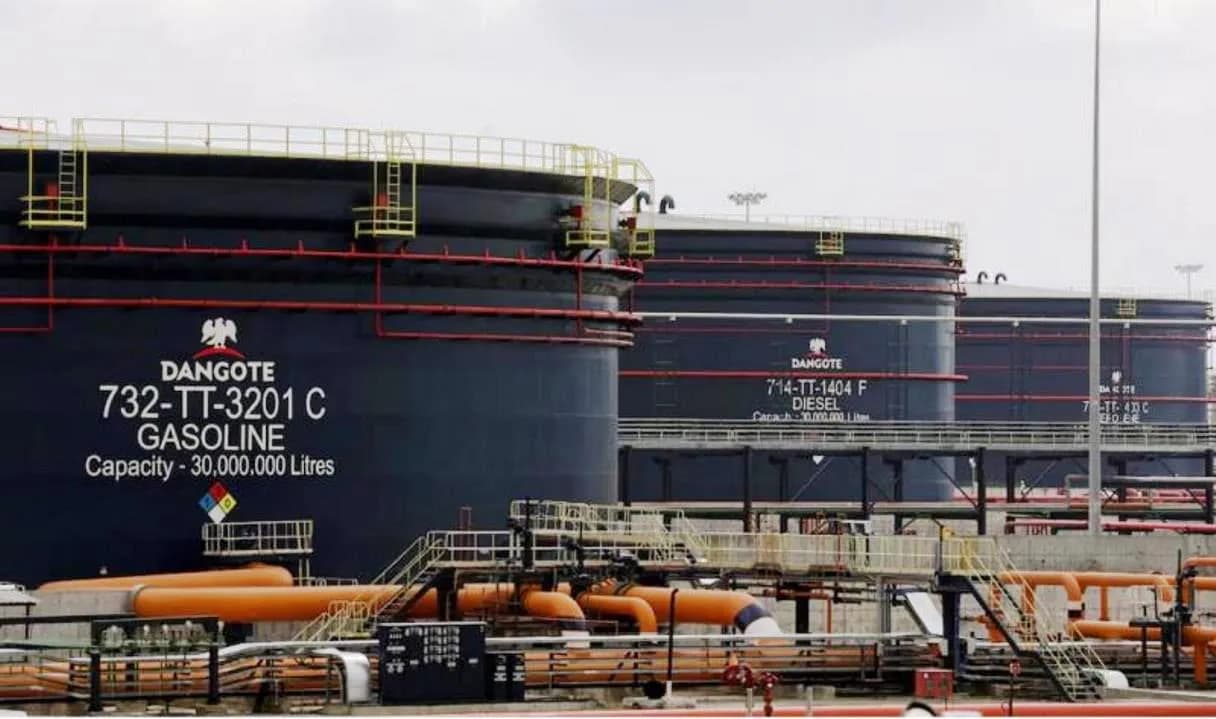
The importation of Premium Motor Spirit (PMS), commonly known as petrol, into Nigeria has seen a sharp decline in the first two weeks of October, as the Dangote Refinery ramps up production to meet local demand. This development was highlighted in a report from S&P Global Commodity Insights, published on Tuesday.
Data from S&P Global Commodities at Sea, accessed by Petroleumprice, shows that only 280,400 barrels of gasoline and blend stock were imported into Nigeria during the first week of October, via a single Medium Range (MR) vessel. This figure represents a significant drop from the 1.3 million barrels imported weekly on average in August.
The report further revealed that during the week ending October 13, only one product tanker, carrying 290,567 barrels from Antwerp to Lagos, delivered gasoline to Nigeria. In contrast, 12 cargoes were shipped in the first half of both August and September. Since October 8, no additional gasoline shipments have arrived in Nigeria.
This disruption in fuel imports is attributed to the increasing refining capacity of the Dangote Refinery, which has begun to reduce the country’s reliance on imports, especially from Northwest Europe. A trade source commented, “There is no schedule for gasoline coming from Europe to Nigeria at the moment. The rest will have to come from whatever is in the Offshore Lome market,” while also noting that the refinery may meet up to 25% of local demand.
Despite the refinery’s growth, traders have warned that Nigeria could still face fuel shortages if imports do not supplement local production.
Earlier this month, following the sale of crude oil to Dangote Refinery in Naira, the federal government authorised petroleum marketers to directly lift petrol from the 650,000 barrels per day (bpd) refinery, bypassing the Nigerian National Petroleum Company (NNPC) Limited. This marks the complete deregulation of the downstream sector, ending the fuel subsidy.
Since September, Dangote Refinery has begun supplying petroleum products, with retail prices initially ranging between N850 and N900 per litre. However, following NNPC’s reduced role as the sole off-taker, prices have risen to between N998 and N1,030 per litre.
The refinery is expected to meet local demand and export to neighbouring African countries and the Caribbean once it reaches full capacity, drastically impacting Nigeria’s petrol importation landscape.