

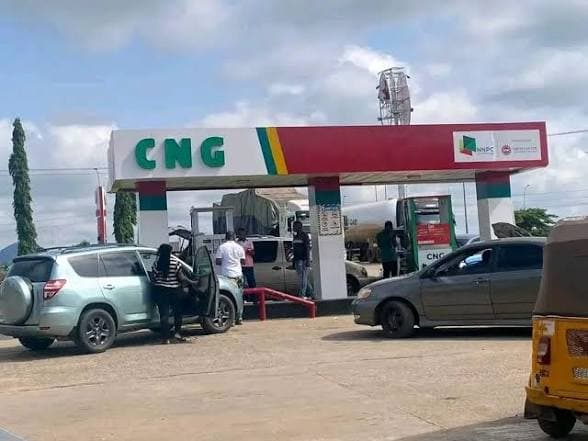
Nigeria’s push to reduce transportation costs through Compressed Natural Gas (CNG) and electric vehicles has yet to translate into widespread fare reductions, with checks across several states showing that commuters continued to pay existing or higher fares after the Federal Government’s October 1 target.
President Bola Tinubu had on September 19 urged state governments to ensure that savings from cheaper CNG-powered transportation were passed on to commuters through lower fares from October 1. The directive followed an August 27 meeting with the 36 state governors under the National Affordable CNG Transit Programme, with the Federal Government targeting measurable reductions in transportation costs.
However, the Chairman of the Presidential Initiative on Compressed Natural Gas and Electric Vehicles, Ismaeel Ahmed, said October 1 was not intended as a date when every state would reduce fares simultaneously, but the point from which the Federal Government would begin monitoring the rollout. He said fare reductions had already started on selected routes in states including Borno, Kaduna, Zamfara and Ebonyi.
The gap between the Federal Government’s rollout and the experience of many commuters is largely linked to limited fleet deployment and infrastructure. Transport operators in several states said they had yet to receive CNG buses, while others cited inadequate refuelling stations, conversion centres, high maintenance costs and poor roads as obstacles to reducing fares.
In Lagos, the Federal Government said it had donated 20 CNG buses to the Lagos Metropolitan Area Transport Authority, while Enugu already had government-owned CNG buses charging ₦300 on selected routes. In Kaduna, 100 CNG buses operate across eight routes under a free mass-transit scheme. The state government said the buses carried about 3.2 million passengers in their first year and saved commuters more than ₦3.5 billion.
Despite these interventions, PUNCH’s checks found that fares remained largely unchanged in Anambra, Delta, Imo, Sokoto, Kebbi, Jigawa, Gombe, Edo, Plateau, Ondo, Osun, Oyo and Ogun states. In Anambra, for instance, commuters continued to pay about ₦700 from Upper Iweka to Oba and around ₦2,000 from Awka to Onitsha, while the Dutse-Kano route in Jigawa remained at about ₦3,500.
The same pressure was evident in other markets. In Ogun, Kuto-Ijebu Ode remained at about ₦3,500, while in Sokoto passengers continued to pay between ₦5,000 and ₦6,000 to Kebbi. In Edo, short-distance fares in Benin remained between ₦200 and ₦300, with longer journeys costing up to ₦600. These figures indicate that the availability of alternative-fuel vehicles has not yet translated into a broad reduction across conventional commercial transport networks.
For transport operators, cheaper CNG alone does not determine the final fare. Vehicle conversion or acquisition costs, availability and reliability of gas supply, refuelling infrastructure, spare parts, maintenance, road conditions and route efficiency all influence operating costs. In some states, operators also said they had not received the vehicles required to participate in the programme.
The development has important implications for Nigeria’s gas and downstream sectors because the success of the CNG programme ultimately depends on building a reliable value chain around the fuel. More conversion centres, refuelling stations and commercially accessible CNG buses are required if lower gas operating costs are to reach a significantly larger share of public transport users.
The October 1 target has therefore marked the beginning of a wider implementation phase rather than an immediate nationwide reduction in fares. While selected CNG and electric transport schemes are already delivering cheaper or free services, the experience across many states shows that sustained fare reductions will depend on wider fleet deployment, reliable CNG infrastructure and the ability of operators to convert lower energy costs into lower passenger fares.