

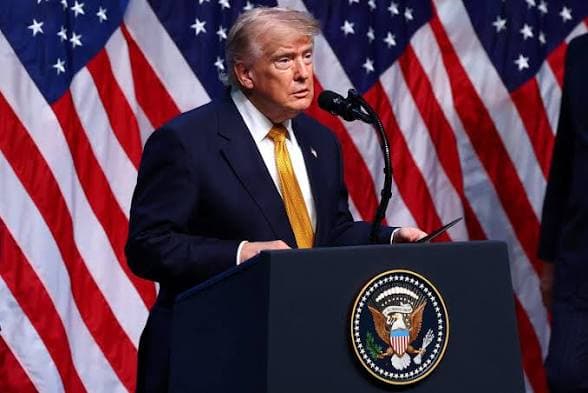
International crude oil prices held firm around the $85 per barrel mark after United States President Donald Trump abandoned his proposed 20 per cent transit fee for cargoes passing through the Strait of Hormuz, opting instead to pursue trade and investment agreements with Gulf states while maintaining Washington's blockade on Iranian shipping.
As at the time of writing 07:45 a.m. (WAT), Brent crude traded at $85.46 per barrel, up 0.86 per cent, while U.S. West Texas Intermediate (WTI) crude rose 0.66 per cent to $79.86 per barrel, according to Oilprice.com. reflecting continued geopolitical risk across the Middle East.
The latest policy shift followed another day of heightened military exchanges between the United States and Iran. Trump announced on Truth Social that he had abandoned plans to impose a 20 per cent U.S. reimbursement fee on cargoes transiting the Strait of Hormuz after holding what he described as productive discussions with Gulf leaders.
"Based on highly productive conversations with Middle East leadership, I have decided to replace the 20% United States Reimbursement Fee with Trade and Investment Deals that the various Gulf States will be making into the United States," Trump wrote. "The investments will be MASSIVE."
Despite dropping the toll proposal, Washington maintained its hardline stance against Tehran. U.S. Central Command (CENTCOM) confirmed that a renewed naval blockade against vessels entering and leaving Iranian ports would remain in force as American forces continued military operations across southern Iran. "CENTCOM forces will enforce the blockade against vessels transiting to or from Iranian ports and coastal areas. The U.S. military continues to support traffic flow through regional waters for all vessels not violating the blockade," the command said.
The conflict also intensified on the Iranian side. Explosions were reported around Bandar Abbas, Bushehr and several strategic islands close to the Strait of Hormuz, while Jordan and Bahrain intercepted Iranian ballistic missiles and the United Arab Emirates reported attacks on vessels in the waterway. Iran's Islamic Revolutionary Guard Corps insisted that restoring normal shipping depended on an end to U.S. military operations in the region.
Iranian Foreign Minister Abbas Araqchi rejected Washington's position, declaring: "Iran has always been the GUARDIAN of the Strait and will remain so FOREVER." Meanwhile, Iran's military warned that countries cooperating with the United States would "bear full responsibility for all insecurity and the escalation of the war in the region."
Although military tensions remain elevated, oil traders appeared to take comfort from Trump's decision to abandon the controversial transit fee, which had raised fears of additional costs for global energy shipments. The absence of the proposed toll helped prevent a sharper rally in crude prices, even as geopolitical risks continued to underpin the market.
For oil-producing countries such as Nigeria, crude prices remaining around $85 per barrel could support stronger export earnings, improve foreign exchange inflows and boost government oil revenues. However, sustained tensions around the Strait of Hormuz continue to pose risks through higher freight charges, increased marine insurance premiums and rising costs for imported refined petroleum products, developments that could eventually feed into Nigeria's downstream fuel market despite improving domestic refining capacity.