

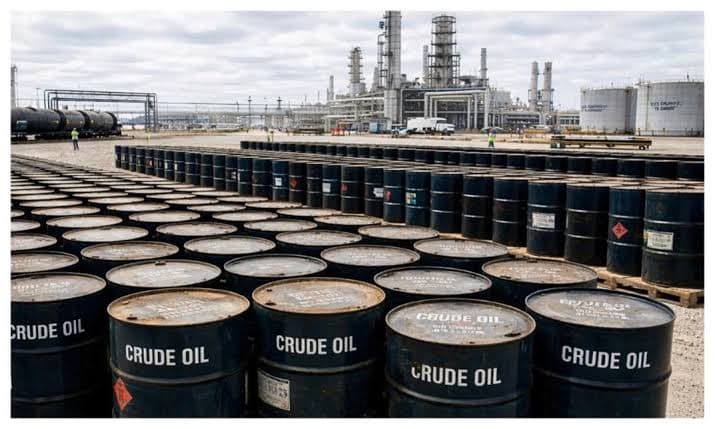
Nigeria produced about 307 million barrels of crude oil and condensate between March and August 2026, as the country’s key crude grades continued to command strong prices in the international market, with Bonny Light trading well above the Brent benchmark.
Data from the Nigerian Upstream Petroleum Regulatory Commission showed that combined crude oil and condensate production averaged 1.67 million barrels per day during the six-month period, rising from 1.56 million bpd in March to a peak of 1.74 million bpd in June before easing slightly in July and August.
As at the time of writing 08:29 am (WAT) Nigeria’s Bonny Light crude was priced at $119.38 per barrel on September 23, according to Central Bank of Nigeria data. The price was about $16.88 above Brent at $102.50 per barrel, representing a premium of approximately 16.5 per cent.
The premium highlights the strong value currently attached to Nigeria’s light, sweet crude in the international market. Bonny Light’s price had reached $126.32 per barrel on September 15, according to CBN data, when Brent was trading at about $108.49 per barrel.
Other Nigerian crude grades are also trading at elevated levels. Oilprice.com lists Qua Iboe at $114.63 per barrel and Brass River at $113.73 per barrel, although both prices carry a five-day market-data delay.
The NUPRC production figures showed that Nigeria generated approximately 48.49 million barrels in March, 49.90 million barrels in April, 52.72 million barrels in May and 52.06 million barrels in June. Output then stood at about 51.80 million barrels in July and 52.01 million barrels in August.
Crude oil accounted for approximately 1.50 million bpd of the six-month average, while condensate contributed about 180,000 bpd. The crude figure also placed Nigeria around its stated 1.50 million bpd OPEC quota, while condensate lifted total liquids production above that level.
The production recovery is particularly significant for Nigeria because higher output allows the country to capture more value from a market in which its crude grades are attracting strong prices. Combined with the premium commanded by Bonny Light, the development has implications for export earnings and government revenue.
Nigeria’s production increased by about 171,298 barrels per day between March and June, before moderating in the following two months. Nevertheless, August output remained above the March level, indicating that the production recovery was sustained despite the decline from the June peak.
The latest figures therefore present two important developments for Nigeria’s upstream sector: crude and condensate production has recovered to around 1.67 million bpd, while key Nigerian grades such as Bonny Light, Qua Iboe and Brass River continue to command prices above the current Brent benchmark.