

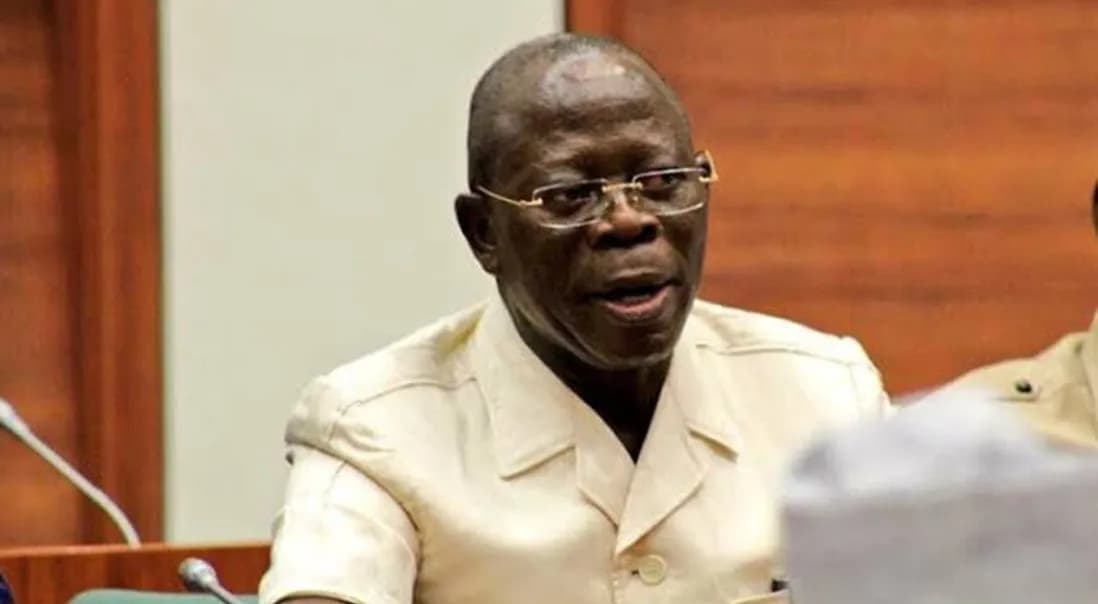
Adams Oshiomhole, former Nigeria Labour Congress (NLC) president and senator, has criticised the Petroleum and Natural Gas Senior Staff Association of Nigeria (PENGASSAN) for shutting down oil facilities nationwide over its industrial dispute with the Dangote Refinery. He described the move as excessive, hasty and detrimental to Nigeria’s fragile energy market.
Union action and wider impact
Speaking on Arise Television, Oshiomhole argued that while unions have the duty to protect workers’ rights, their methods must not trigger economic disruption across unrelated sectors.
“I think that in seeking to protect a particular set of workers, you do not then risk the jobs of several other workers. When you are pursuing a dispute, the tools you deploy must be such that they do not undermine other people’s jobs,” Oshiomhole said.
His remarks followed PENGASSAN’s directive that led to temporary closures at Nigerian National Petroleum Company Limited (NNPCL) facilities and other firms. The shutdown caused sudden fuel queues in major cities, heightening concerns over supply security.
Lessons from past labour struggles
Drawing on his NLC leadership experience, Oshiomhole stressed that industrial disputes should remain confined to the employer in question. He recalled the union’s clash with Union Bank of Nigeria over discriminatory policies, noting that although labour had the power to cripple the entire banking sector, it chose restraint to prevent wider economic harm.
“In pursuing war, you have to recognise that the tools you deploy must not hurt innocent people, like the tomato sellers who cannot get fuel to move their goods because there is a quarrel between one refinery and one union,” he added.
Balancing workers’ rights and business survival
Oshiomhole also called for a more balanced approach between labour demands and the survival of private investment, particularly in the case of Dangote Refinery, Africa’s largest single-train facility.
“An employer has to exist, mature and be strong enough to guarantee good-paying jobs. If you cripple a business before it even finds its feet, you are also destroying the jobs you claim to protect,” he warned.
Broader energy market concerns
The strike came at a time when Nigeria’s oil production has already faced headwinds, with NNPCL reporting a 16.1% slump during the standoff. Analysts say the development underscores how fragile Nigeria’s downstream sector remains, with disruptions at a single refinery spilling into national supply chains.
While affirming the constitutional right to unionise, Oshiomhole urged both PENGASSAN and management to pursue dialogue rather than brinkmanship. “Nigeria needs stability in its energy market. We cannot afford self-inflicted disruptions,” he said.