

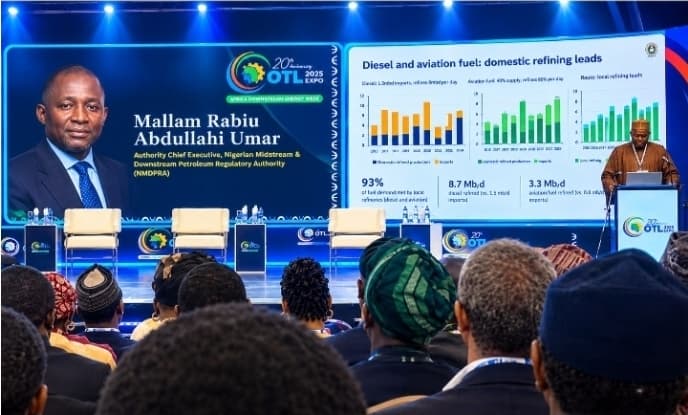
The Nigerian Midstream and Downstream Petroleum Regulatory Authority (NMDPRA) has set a target of 30 to 45 days of petroleum product sufficiency as Nigeria seeks to strengthen energy security amid growing domestic refining capacity.
The Authority Chief Executive, Rabiu A. Umar, disclosed this on Monday while delivering the keynote address at the 20th OTL Africa Downstream Energy Week in Lagos, where he outlined the regulator’s priorities for improving supply security, expanding infrastructure and attracting fresh investment into the oil and gas sector.
Umar said domestic refineries now account for 74 per cent of Nigeria’s petrol supply, up from approximately 44 per cent in September 2025, while petrol imports have declined by 54 per cent, from 22.1 million litres per day to 10.2 million litres per day.
He, however, noted that domestic supply remained below consumption, with daily petrol supply averaging 38.7 million litres against consumption of 44.4 million litres in September 2026.
According to him, the shortfall was being met from existing stocks, while petrol inventories currently covered about 24 days, below the authority’s proposed sufficiency target.
To strengthen the country’s ability to withstand supply disruptions, the NMDPRA plans to pilot a national strategic stock programme with the Nigerian National Petroleum Company Limited at depots in Ibadan, Enugu and Suleja.
The authority also plans to establish a national system for measuring actual fuel consumption at filling stations to improve demand forecasting and supply planning.
On domestic refining, Umar said active refining capacity had increased to 682,000 barrels per stream day from 5,000 bpsd in 2021. Local refineries also accounted for 93 per cent of diesel receipts in September, according to the presentation.
He attributed the sector’s transformation to developments following the Petroleum Industry Act of 2021, which he said had also supported growth in gas infrastructure and supply.
The authority reported that liquefied petroleum gas supply had risen by 50 per cent to 1.8 million metric tonnes from 1.2 million tonnes in 2021, while the number of compressed natural gas compression facilities increased from 17 to 43.
Umar said sustaining the gains would require further investment in refining, gas processing, storage and transportation infrastructure.
He estimated that Nigeria needed between $30bn and $50bn in fresh oil and gas investment, identifying industrial processing, fertiliser production, liquefied petroleum gas and flare-gas commercialisation as priority areas.
He also highlighted the need to expand gas transportation capacity from 2.2 billion cubic feet per day to 4.2 billion cubic feet per day through the development of the Ajaokuta-Kaduna-Kano and Obiafu-Obrikom-Oben pipeline projects.
On market regulation, the NMDPRA said it was working with the Federal Competition and Consumer Protection Commission to strengthen consumer protection and coordinated enforcement. It also plans to finalise regulations on anti-competitive practices and expand the modernisation of petroleum product testing laboratories.
The authority further called for stronger regional cooperation among African countries, noting that about 70 per cent of the continent’s refined fuel was imported despite crude oil production of approximately five million barrels per day.
Umar urged African countries to increase domestic refining, develop shared infrastructure, align fuel quality standards and coordinate strategic reserves to strengthen regional energy security.
He said the authority’s priorities would be pursued through predictable licensing, market transparency, infrastructure investment and stronger collaboration with industry stakeholders.