

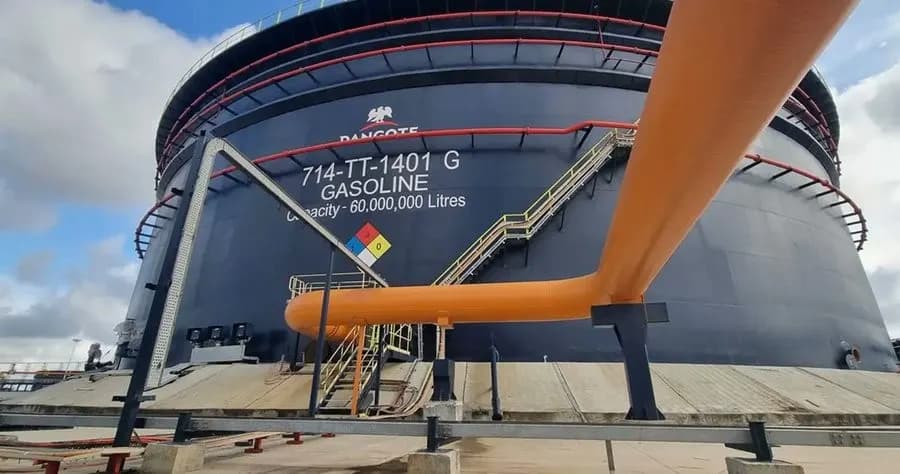
The suspension of petrol import licences in Nigeria has effectively placed the Dangote Petroleum Refinery at the centre of the country’s fuel supply chain, with industry data indicating that the refinery now dominates a petrol market estimated at ₦14.4 trillion annually, according to a report by The PUNCH.
Energy experts, labour groups, and economists have raised concerns about the implications of the development, warning that heavy reliance on a single supplier could create long-term risks for pricing, competition, and energy security.
Recent data from the Nigerian Midstream and Downstream Petroleum Regulatory Authority (NMDPRA) shows that domestic refining accounted for the overwhelming majority of petrol supply in February 2026 after authorities halted the issuance of new import licences.
Figures contained in the regulator’s February market fact sheet indicate that local refineries supplied about 36.5 million litres of petrol per day, while imports contributed roughly three million litres daily.
This placed total national supply at approximately 39.5 million litres per day, with domestic production representing about 92 per cent of the volume.
Analysts say the shift marks a major departure from Nigeria’s long-standing dependence on imported petrol, a situation that persisted for years due to the poor performance of state-owned refineries.
At present, the Dangote refinery is the only facility producing petrol locally, while other smaller modular refineries largely focus on diesel and related products.
Using a conservative petrol price estimate of ₦1,000 per litre and the average daily consumption of 39.5 million litres, the country’s petrol market could generate more than ₦14.4 trillion annually, depending on global crude price movements and domestic pricing.
Experts Warn Over Market Concentration
The rapid shift toward domestic supply has triggered debate among industry stakeholders over the possibility of excessive market concentration.
Energy economist Professor Wumi Iledare described the suspension of petrol imports as a significant policy signal in Nigeria’s evolving downstream sector, but warned that abrupt regulatory changes could encourage strategic behaviour among market participants.
According to him, such signals can sometimes lead to precautionary stockpiling, opportunistic pricing, or competition for logistical advantages within the supply chain.
He noted that the available data suggests the market is still adjusting to the new structure created by rising domestic refining output and falling imports.
For the policy to succeed, Iledare said regulatory authorities must ensure clear communication and provide assurances that local production, distribution infrastructure, and market pricing can consistently meet national demand.
Regulator Must Safeguard Competition
Energy law expert Professor Dayo Ayoade also emphasised the role of regulators in maintaining a competitive environment in the downstream sector.
He noted that Nigeria’s current dependence on the Dangote refinery largely reflects structural weaknesses in the country’s refining capacity rather than deliberate market control by the company.
According to him, the regulator has a legal mandate under the Petroleum Industry Act (PIA) to monitor competition and intervene if necessary.
Ayoade added that if evidence emerges that a dominant supplier is abusing its market position, regulatory authorities retain the power to impose sanctions or corrective measures.
He also said increased competition is likely to emerge over time as more refining projects come on stream.
Energy Security Concerns Raised
Some analysts have warned that relying heavily on a single refinery could expose Nigeria to supply disruptions in the event of operational challenges.
The Chief Executive Officer of Petroleumprice.ng, Jeremiah Olatide, said that while the growth of domestic refining is a positive development, a more balanced supply structure may provide greater stability.
According to him, a system that combines both local refining and a limited level of imports could strengthen energy security while allowing competition to develop naturally.
Olatide suggested that a supply mix in which about 70 per cent of petrol demand is met locally and 30 per cent through imports may provide a more stable transition for Nigeria’s fuel market.
He also argued that restrictions on import licences may have accelerated the refinery’s dominance in the market.
Labour, Economists Call for Safeguards
Labour unions and economic analysts have also raised concerns about the concentration of supply in a single facility.
The Nigeria Labour Congress (NLC) warned that dominance by a single supplier in a sector as critical as fuel could expose consumers to pricing pressures if adequate regulatory oversight is not maintained.
According to NLC Assistant Secretary-General Christopher Onyeka, competition plays a key role in preventing excessive pricing power in any economy.
He urged authorities to ensure that consumer interests remain protected while the downstream market continues to transition away from heavy import dependence.
Economist Aliyu Alias similarly cautioned that the absence of multiple refining players could allow a dominant supplier to influence petrol prices significantly.
He noted that the lack of fully operational public refineries and limited participation by other private refiners have reduced competitive pressure in the sector.
Government Defends Local Refining Strategy
Meanwhile, the NMDPRA has defended the decision to suspend petrol import licences, saying the policy is aimed at consolidating the gains made in domestic refining.
The authority’s Chief Executive, Saidu Mohammed, said Nigeria must sustain its progress toward local fuel production rather than return to large-scale importation.
He explained that Nigeria’s petroleum sector has historically moved through different phases, from early domestic refining to heavy reliance on imported petrol following the decline of state-owned refineries.
According to him, the emergence of the Dangote refinery represents a new stage in the sector’s development, with domestic refining now capable of meeting national requirements.
However, he acknowledged that some interests within the industry still favour a return to extensive petrol imports.
Global Oil Market Volatility
The restructuring of Nigeria’s petrol market is unfolding against the backdrop of volatility in global oil markets linked to geopolitical tensions in the Middle East.
The International Energy Agency (IEA) recently announced plans by its member countries to release 400 million barrels of oil from emergency reserves, the largest coordinated release in the organisation’s history.
The move is aimed at easing supply disruptions caused by tensions affecting the Strait of Hormuz, a critical maritime route that handles roughly 20 per cent of global oil and gas shipments.
Crude oil prices hovered around $90 per barrel during the week, reflecting ongoing uncertainty in international energy markets.
Pump Prices Adjust
Following recent price reductions from refinery gantry rates, several filling stations across Nigeria have also adjusted pump prices.
Market checks showed petrol selling between ₦1,130 and ₦1,150 per litre at some retail outlets, although a few stations continued to sell at higher rates depending on supply conditions.
Industry observers say the evolution of Nigeria’s downstream sector will depend largely on how regulators balance support for domestic refining with policies that encourage competition and protect consumers.