

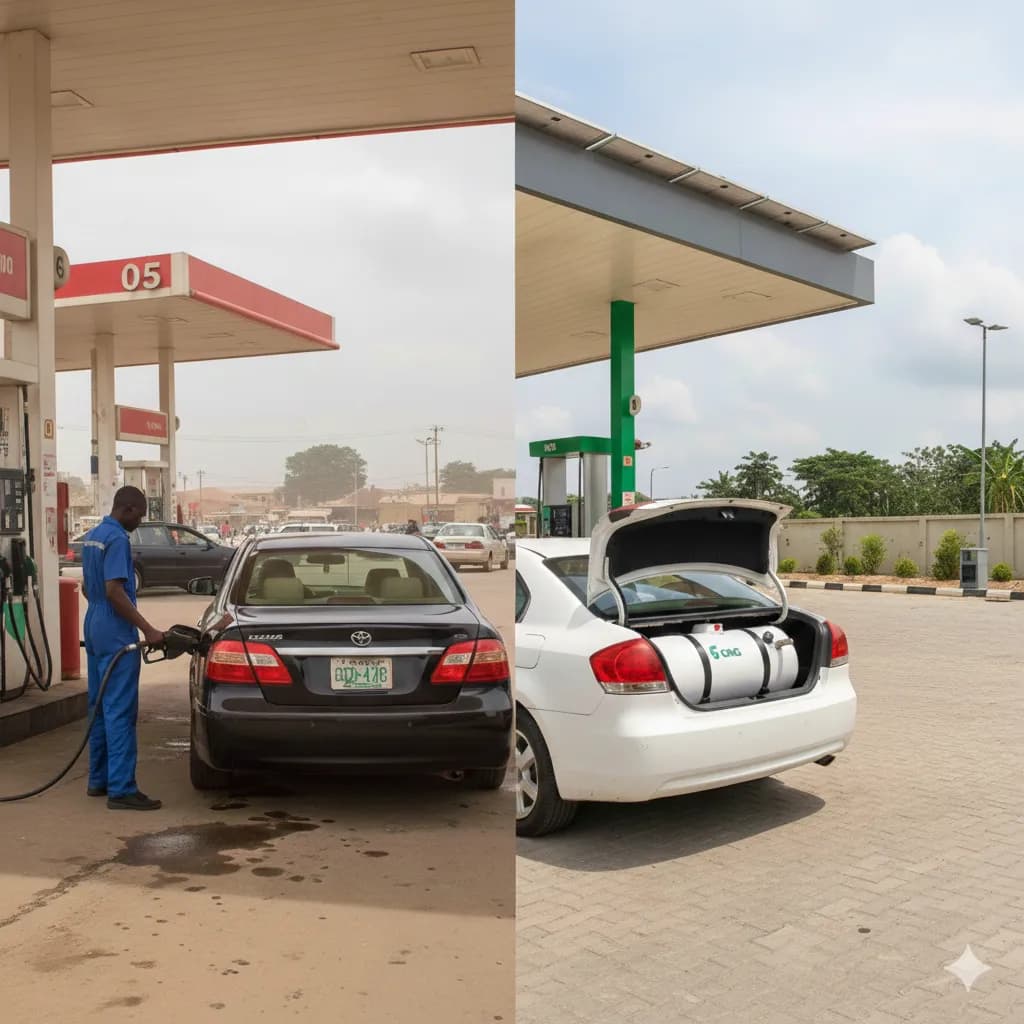
Nigeria stands at a crossroads. With rising petrol prices and growing pressure on motorists’ wallets, the allure of Compressed Natural Gas (CNG) seems obvious cheaper fuel, cleaner burn, lower emissions. Yet, the bulk of Nigerian drivers remain loyal to petrol. The reasons are not rooted in ignorance, but in structural weaknesses, economic realities and market inertia that shape everyday decisions. Below, we unpack the most critical obstacles using real industry data and insight.
1. Inadequate CNG Infrastructure: The Supply Gap Reality
Although the CNG agenda in Nigeria has seen rapid growth, the infrastructure remains insufficient to support mass adoption. As of April 2025, the national CNG network reportedly includes around 27 “mother” compression hubs and 63 refuelling (daughter) stations, plus roughly 242 certified vehicle‑conversion centres.
For a country with thousands of vehicles and many travellers commuting between states this is simply not enough. The uneven distribution, especially in northern and south‑eastern regions, means many potential users would have to drive far just to refill. Even though the government has announced plans to roll out 500 additional CNG stations over the next three years to close gaps.
Until CNG refuelling points become as common and accessible as petrol stations, motorists will naturally stick to petrol for convenience and reliability.
2. High Conversion Costs: Barrier to Entry Remains Steep
Transitioning from petrol to CNG is not just about filling up differently it often means converting your vehicle. And that conversion comes with a hefty price tag. Investigations show that retrofitting a standard car can cost between ₦900,000 and ₦1.5 million, inclusive of kits and installation.
For many Nigerian drivers especially private commuters, small‑business owners or operators of commercial vehicles this upfront cost is prohibitively high. While CNG might provide long‑term savings, the significant expense upfront weakens its appeal. Experts have noted that in similar contexts abroad, adoption surged only after subsidies or financing plans offset conversion costs.
In short: when wallets are tight, future savings matter little affordability now calls the shots.
3. Limited CNG Expertise Among Technicians: Reliability and Maintenance Risk
CNG conversion and maintenance is not a trivial plug‑and‑play exercise. It requires properly certified technicians, calibrated installations, reliable supply chains for spare parts and quality assurance to ensure safety. However, reports suggest that many workshops in Nigeria remain unlicensed or under‑trained, and the number of truly competent CNG technicians is still too small.
This shortfall raises valid fears among motorists: faulty conversion, poor maintenance, or breakdowns with no skilled help nearby. Many therefore opt for petrol a fuel system any mechanic can service, any day, anywhere.
Without a large, well-distributed network of trained professionals, the CNG ecosystem remains fragile, undermining trust and reliability.
4. Public Concern Over Explosion Risks: Perception vs Reality
Even if infrastructure and expertise improve, the psychological barrier remains. Many Nigerians still distrust gas systems, fearing that compressed cylinders might explode or malfunction especially amidst sporadic media reports of accidents linked to poorly converted vehicles. Observers note that such safety concerns continue to weigh heavily on public acceptance.
In a context where regulatory enforcement can be inconsistent, these fears are amplified. For many, the risk however statistically small is not worth taking. And so petrol, the familiar and “safe” default, retains its grip on the majority.
5. Low Awareness and Understanding of CNG Benefits: Knowledge Gap Persists
Despite publicised campaigns and policy push, knowledge about CNG, how it works, where to convert vehicles, where to refuel, cost-benefit calculations remains patchy across large segments of the population. Many motorists simply don’t know where to start or who to trust. Analysts have argued that until average Nigerians can “see, touch and use” the technology regularly, the adoption curve will remain flat.
Moreover, inconsistent messaging and limited visibility of successful CNG users have left many unconvinced. Without widespread public understanding and trusted conversion/maintenance ecosystems, CNG remains more of a government policy than a lived reality.
Structural Fixes Needed Before Behaviour Changes
The push for CNG in Nigeria is well-intentioned and, in many respects, bold. From promising plans to build 500 new refuelling stations, to substantial investments and rapid growth in conversion centres progress is evident.
Yet, the core reasons why millions of Nigerians still prefer petrol are clear: limited supply points, high conversion cost, insufficient technical capacity, safety concerns and low public awareness.
If Nigeria is to make significant inroads in replacing petrol with CNG, stakeholders need to:
- aggressively expand refuelling infrastructure nationwide;
- subsidise or finance vehicle conversions;
- scale up training and certification of CNG technicians;
- run transparent public safety and education campaigns;
- and demonstrate reliability through visible success stories.
Only then will the perceived benefits of CNG cost‑saving, clean fuel, Sustainability become real for everyday motorists. Until then, petrol will remain the default choice on Nigeria’s roads.