
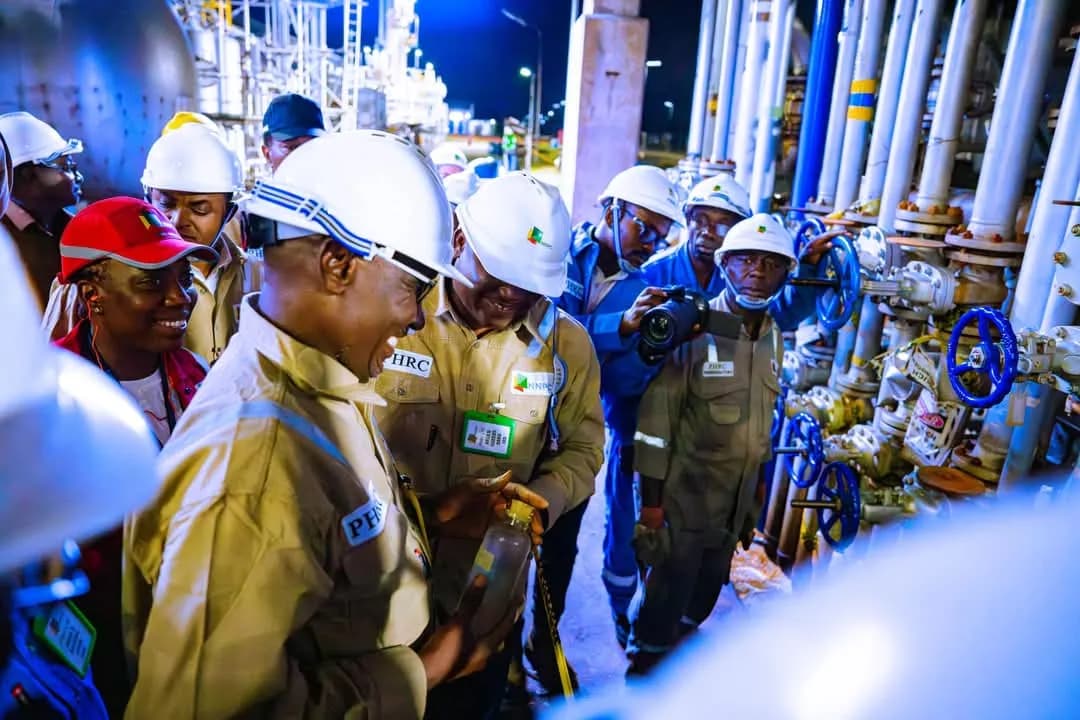
After seven postponements, and expending over $1.5 billion, the Port Harcourt Refinery Company(PHRC) has finally resumed operations, releasing about one million litres of refined products on its first day. This marks the beginning of an output of approximately 200 trucks of petroleum products daily.
The Nigerian National Petroleum Company Limited (NNPCL) announced the refinery’s relaunch, showcasing an upgraded facility with a production capacity of 70% of its installed capacity. The revamped old Port Harcourt Refinery, initially designed for 60,000 barrels per day (bpd), is now operational, although its larger counterpart at Eleme, with a capacity of 150,000 bpd, remains dormant.
NNPCL Group CEO, Mele Kyari, expressed optimism about the ongoing projects at the PHRC but refrained from committing to timelines, citing President Bola Tinubu’s directive to avoid further postponements. “We will deliver all the other projects. We are not going to give a timeline, as he (Tinubu) has directed,” Kyari said.
During the unveiling, stakeholders, including regulators and marketers, witnessed fuel sampling and truck loading activities at the facility. Farouk Ahmed, Chief Executive of the Nigerian Midstream and Downstream Regulatory Authority, hailed the development as a game-changer, noting that combined production from the Port Harcourt and Dangote refineries would ensure nationwide fuel availability.
“This will promote competition, availability, and affordability,” Ahmed stated, adding that Nigeria’s journey to becoming a net exporter of petroleum products could soon become a reality.
However, the resumption faced scrutiny, with claims that the refinery lacked a catalytic platform unit for petrol production. Critics argued that the facility could only refine crude for non-PMS products. NNPCL dismissed these allegations, maintaining that the refinery is operational and working to ramp up capacity to 90%.
The corporation further clarified its blending process, emphasising that the use of crack C5 from Indorama Petrochemicals meets global standards. “Blending is a standard practice in refineries globally,” said NNPCL spokesperson Olufemi Soneye.
Petroleum marketers have expressed excitement about lifting products from the state-owned refinery. “It’s a dream come true,” said Joseph Obele of the Petroleum Products Retail Outlet Owners Association of Nigeria (PETROAN).
Independent Petroleum Marketers Association of Nigeria (IPMAN) spokesperson Chinedu Ukadike praised the development at the PHRC, stating, “Deregulation has removed monopolies. Competition is here, and marketers now have options.”
President Tinubu lauded the milestone, attributing its success to initiatives from former President Muhammadu Buhari and NNPCL’s leadership. He urged for the speedy completion of other refineries in Warri and Kaduna.
“With this achievement, Nigeria is on its way to becoming an energy hub,” Tinubu stated, reaffirming his administration’s commitment to enhancing energy security and boosting export capacity.
The Port Harcourt refinery’s revival positions it as a potential competitor to the 650,000-bpd Dangote Refinery, marking a significant step towards addressing Nigeria’s energy challenges.