

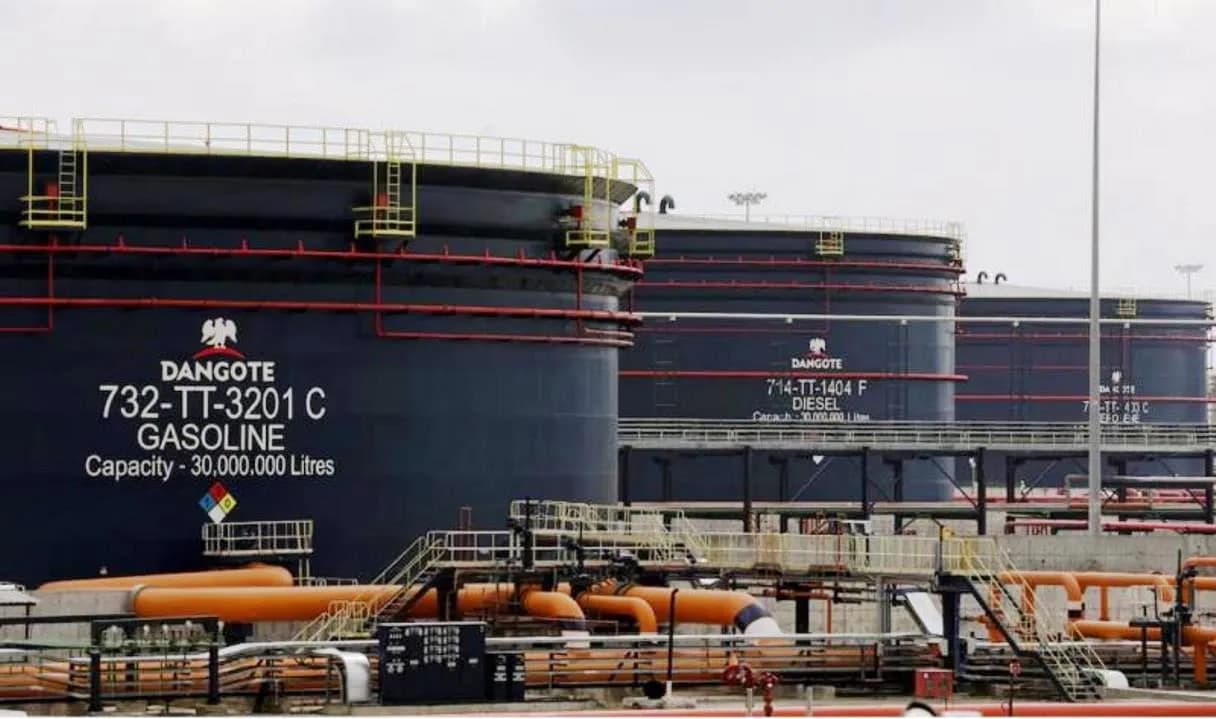
Nigeria’s downstream oil market has entered a full-blown price war as petrol prices retreat sharply across major depots, following Dangote Petroleum Refinery’s introduction of a ₦20-per-litre volume-based bonus for marketers. The move has triggered rapid price adjustments by private depot owners, intensifying competition for market share and reshaping pricing dynamics nationwide.
The latest round of price crashes comes barely days after Dangote raised its PMS price from ₦699 to ₦799 per litre, a decision that saw truck loading volumes fall and marketers increasingly turn to alternative depots closer to their operating zones.
Dangote’s Bonus Strategy Sparks Market Repricing
To arrest declining gantry activity and retain high-volume buyers, Dangote Refinery rolled out a weekly PMS lifting bonus effective February 2, 2026. Marketers lifting between 2 million and 4.99 million litres weekly qualify for a ₦20 per litre rebate, while those lifting 5 million litres and above earn ₦25 per litre.
Rather than adjust its official ex-depot price downward, the refinery opted for a targeted incentive structure that effectively reduced marketers’ net landing costs. The impact was swift. In Lagos, Dangote’s PMS price softened from about ₦799.5 on February 3 to roughly ₦775 by February 6, signalling a tactical retreat aimed at restoring volumes.
Private Depots Forced Into Price Cuts
Dangote’s move immediately pressured private depots to respond. In Lagos, PMS prices adjusted downward across key operators, with Nipco and Emadeb easing to ₦790. This marked a clear reversal from earlier levels when private depots undercut Dangote following its ₦100 price increase.
The repricing trend extended beyond Lagos. In Warri, PMS prices that hovered around ₦819–₦820 on February 3 dropped to between ₦816 and ₦817 by February 6. Port Harcourt also saw prices retreat from ₦833–₦835 to about ₦828, while Calabar depots adjusted from above ₦830 to roughly ₦816.
Market operators say the coordinated downward movement reflects competitive pressure rather than logistics relief, as depot owners scramble to defend volumes in the face of Dangote’s incentive-backed pricing.
Diesel Market Also Feels the Heat
The price war is spilling into the Automotive Gas Oil segment. In Lagos, Dangote’s AGO price edged down from ₦912 to ₦911 per litre within the same period, while private depots such as Ibeto and Aiteo adjusted to about ₦907. The narrowing spread suggests that refiners and depot owners are aligning prices tightly to prevent customer migration.
Industry analysts describe the current situation as a recalibration phase in Nigeria’s deregulated downstream market. Dangote’s decision to defend market share through rebates rather than headline price cuts has forced competitors to slash prices, accelerating a broader market correction. As long as demand remains price-sensitive, observers expect the fuel price war to persist, with marketers and depot owners continuously adjusting to stay competitive.