

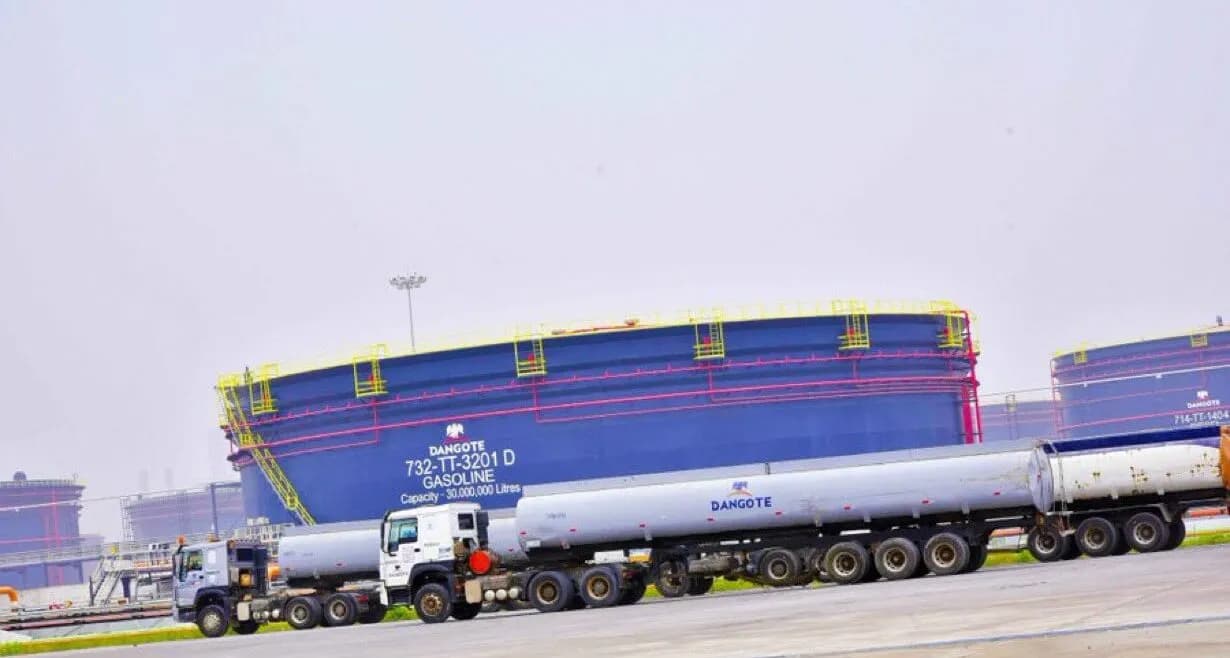
The Nigerian downstream petroleum sector is undergoing a seismic shift. Today Monday saw many private depots across the country particularly in Lagos stood deserted as the Dangote Refinery officially rolled out large-scale petrol distribution to retail outlets across 12 states in Nigeria, Petroleumprice.ng correspondent confirms the trucks movement. Marketers and retailers, long tethered to private depot supply chains, have redirected their trucks to Dangote’s gantries where the price advantage is simply too strong to ignore.
Dangote’s Price Undercuts Market Rates
At the refinery’s gantry, petrol loaded at ₦820 per litre, a clear disruption against prevailing Lagos depot prices. On Friday, WOSBAB and AITEO sold at ₦836, while MENJ was priced at ₦838. That price differential, although modest on paper, carries significant weight when scaled across thousands of litres enough to tilt marketers’ loyalty.
The impact was immediate: depots in major hubs were emptied of truck traffic. Industry players describe the shift as a classic case of market displacement, with Dangote leveraging its refining capacity to dictate ex-depot dynamics.
Empty Depots in Lagos’ Critical Corridors
The emptiness was striking. In the Dockyard axis, AITEO and NIPCO depots had no truck movement. Across the Satellite Town corridor, MENJ, First Royal, and Rainoil were left idle. The Coconut axis mirrored the silence, with Sahara, Bono and Integrated, have all been scanty seeing zero movement of trucks.
The pattern extended beyond Lagos. Reports from Calabar and Port Harcourt also indicated deserted depots, underscoring the refinery’s national pull and its ability to rapidly redirect demand.
Tension in the Downstream Market
Depot owners are on edge. The consensus among operators is that Dangote’s pricing strategy and throughput scale represent an existential threat to traditional depot margins. With demand consolidating around a single player, private depots risk redundancy unless they innovate or restructure.
Analysts warn that sustained undercutting could accelerate supply chain realignment, forcing depot owners into either strategic partnerships or market exit. For consumers, however, the shift offers hope of lower pump prices and improved supply stability.
A Market in Transition
Dangote’s entry into active distribution has not only altered supply routes but also reshaped bargaining power in Nigeria’s downstream sector. By displacing private depots, the refinery is positioning itself as the central node in national fuel logistics.
The message is clear: Nigeria’s petroleum landscape is no longer business as usual. For the first time in decades, one refinery has managed to bend the market in its direction, and the aftershocks are only beginning.