

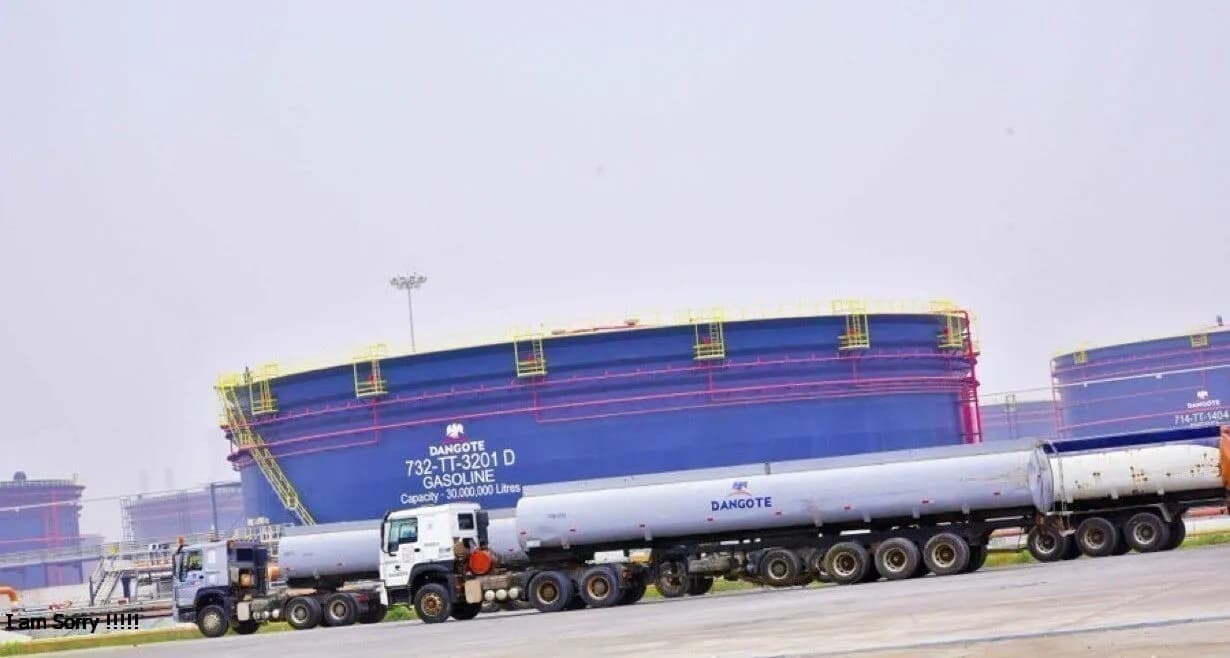
Nigeria’s private fuel depots are losing traffic as tanker operators and marketers divert en masse to the Dangote Petroleum Refinery, following renewed price increases at major loading points.
Industry checks by Petroleumprice.ng on Monday show that several private depots across Lagos, Warri, Port Harcourt, and Calabar recorded thin or near-empty loading activity, while truck movement surged at Dangote’s Lekki facility.
Market operators say the shift reflects a widening price gap that now favours Dangote as the cheapest bulk supplier in the domestic market.
Dangote is currently selling petrol at ₦700.50 per litre, undercutting competing depots by over ₦100 per litre in some locations.
Trucks Divert to Dangote as Depot Prices Rise
Depot operators across key coastal hubs adjusted prices upward on Wednesday, prompting immediate changes in truck routing.
Lagos depots loaded at:
- Rainoil – ₦800
- Wosbab – ₦805
- Emadeb – ₦810
Warri depots:
- AYM Shafa – ₦800
- Rainoil – ₦805
Port Harcourt:
- Matrix – ₦802
Calabar:
- Sobaz – ₦795
- Matrix – ₦798
In contrast, Dangote maintained a ₦700.50 ex-gantry price, making it the clear cost leader. Truck drivers and marketers told Petroleumprice.ng they now bypass private depots to load directly from Dangote.
“Once private depots raised prices again, the decision became simple,” a marketer said. “You cannot compete when Dangote is over ₦100 cheaper per litre.”
Dangote Now Supplies the Bulk of Domestic Demand
Beyond pricing, volume has become Dangote’s biggest advantage.
The refinery currently loads about 43 million litres of petrol per day, equivalent to roughly 1,000 trucks daily. Industry estimates indicate this represents nearly 70% of Nigeria’s daily fuel consumption.
With that scale, Dangote now functions as the primary wholesale hub for the downstream market, drawing truck traffic away from independent depots that once dominated coastal distribution.
Logistics operators say most loading slots at Dangote are fully booked, while several private depots recorded minimal dispatch activity during peak trading hours.
Market Power Shifts to a Single Supplier
Analysts warn that the desertion of private depots signals a structural shift in Nigeria’s downstream sector.
For years, coastal depots in Lagos, Warri, Port Harcourt, and Calabar served as the backbone of fuel distribution. However, sustained price undercutting by Dangote now places the refinery at the centre of the supply chain.
While marketers welcome lower ex-gantry prices, some industry players caution that over-concentration of supply could reshape pricing power if competitors fail to remain active.
For now, the economics are decisive.
As one depot operator put it: “At these prices, trucks will keep heading to Dangote. The market is simply following the cheapest molecule.”
What It Means for Prices and Competition
If current trends persist:
- Private depots may continue losing volume, limiting their ability to influence wholesale pricing.
- Dangote’s market share could expand further, tightening its grip on domestic supply.
- Retail pricing may remain under pressure in the short term, as cheaper ex-gantry costs filter through the distribution chain.
But industry observers note that sustained competition depends on whether independent depots can recalibrate pricing or secure alternative supply at competitive rates.