
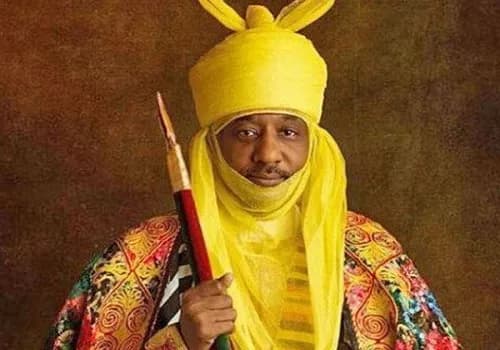
The Emir of Kano, Muhammad Sanusi II, expressed concern on Thursday over what he referred to as deliberate efforts to frustrate the progress of Dangote Refinery due to vested interests.
The emir noted that with the establishment of a privately-owned, indigenous refinery, Nigeria should be reaping the benefits of ending fuel importation.
Sanusi made this statement during the launch of the book, Public Policy and Agents Interests: Perspectives From The Emerging World, authored by former Finance Minister, Shamshudeen Usman, along with contributions from others, including the emir himself.
For several weeks, Dangote Refinery has been embroiled in a dispute with the Nigerian National Petroleum Company Limited (NNPCL) over issues related to crude supply and pricing.
However, on Wednesday, President Bola Tinubu’s special adviser on information and strategy, Bayo Onanuga, stated that the federal government would not intervene in the ongoing fuel price dispute between Dangote Refinery and the NNPCL.

The former Central Bank Governor remarked, “The Nigerian state has been captured by a rent-seeking class that views the state as a source of personal gain rather than as a vehicle for development. This mindset is what has led to the destruction of Nigeria. People enter office, and their primary concern is how much they can extract from the state, not how they can use their position to serve the people.
“There are numerous examples of public servants who have acted with integrity and served the country well. So why is Nigeria still in this condition?
“They point to the Dangote Refinery, where issues have arisen. I don’t know the full details, but this is a country that has been importing petroleum products for decades. This was an opportunity to break free from that dependency, yet instead of embracing it, we are hindering its progress.
“Why would anyone oppose our ability to produce refined petroleum products domestically? Because there are vested interests who have profited from Nigeria’s continued reliance on imports. These could be international oil marketers or local beneficiaries of the subsidy scams. But once we stop importing and start producing locally, all excuses vanish,” Sanusi stated.
Turning to the book’s lead author, Sanusi commended Usman, noting that he had been his lecturer at university. He praised Usman for his long public service career, adding that it was impressive that Usman had never been summoned by the EFCC, saying, “It’s rare.”
In the same vein, Vice President Senator Kashim Shettima, represented by his special adviser, Aliyu Modibbo, assured that the Tinubu administration is committed to “preventing policy capture by special interests.” He emphasised that the government is focused on safeguarding policies to ensure they benefit the Nigerian people and is “investing in capacity building for government officials” to achieve this.
The book’s author, Usman, encouraged the use of the book for research purposes and emphasised the need to improve governance and policy. Recounting his personal experiences, he thanked God for blessing him with good health and a supportive family. He quipped, “Some of you are 50 years old, but I can challenge many of you here to run a marathon, and I’ll beat you.”
The book reviewer, Joe Abah, described the work as insightful and a valuable resource for scholars and students. He thanked Usman and the contributors for undertaking the task and stated that it would aid in shaping government policy. Abah dismissed claims that Nigeria’s challenges are due to policy formulation, suggesting instead that the issue lies in policy intent.
In a surprising moment during the event, former President Goodluck Jonathan and Sanusi debated the circumstances surrounding Sanusi’s suspension as CBN governor in 2014.
Sanusi had been suspended during Jonathan’s tenure following his claim that $49 billion was missing from government coffers. Responding to this in the book, Jonathan denied the claim and said such an amount could not have been stolen under his administration.
Jonathan, who chaired the book launch, acknowledged the importance of the book and its contribution to policy discussions but disagreed with Sanusi’s claim about the missing $49 billion. He argued that it would have been impossible for Nigeria, with a budget of $32 billion at the time, to lose such a sum without the country feeling the effects.
The former president recalled being questioned by German Chancellor Angela Merkel about the claim and explaining that such an amount could not have been stolen from Nigeria. He also mentioned that subsequent investigations by PriceWaterhouseCoopers (PwC) and a Senate Finance Committee, led by Senator Ahmed Makarfi, found that while $1.48 billion remained unaccounted for by the NNPC, there was no evidence to support Sanusi’s $49 billion figure.
Jonathan stated, “I did not completely agree with some issues raised by one of the contributors. But I won’t debate them because he is our royal father, and he is here.
“The claim that he was sacked for whistleblowing about $49.8 billion being lost by the Federal Government is not accurate. He wasn’t sacked; he was suspended following a query from the Financial Reporting Council regarding serious infractions at the CBN. However, before these matters were fully resolved, his tenure ended.”
Jonathan concluded by reiterating that he remains unconvinced that $49.8 billion was ever missing from government coffers.
In response, Sanusi took the podium shortly after Jonathan’s remarks and reaffirmed his stance, insisting that he had been “constructively dismissed” by Jonathan.
He said, “My boss who sacked me. I was constructively dismissed.” Sanusi emphasised that he harboured no ill will towards Jonathan, saying, “I continue to respect Jonathan and hold no grudges against anyone.”