

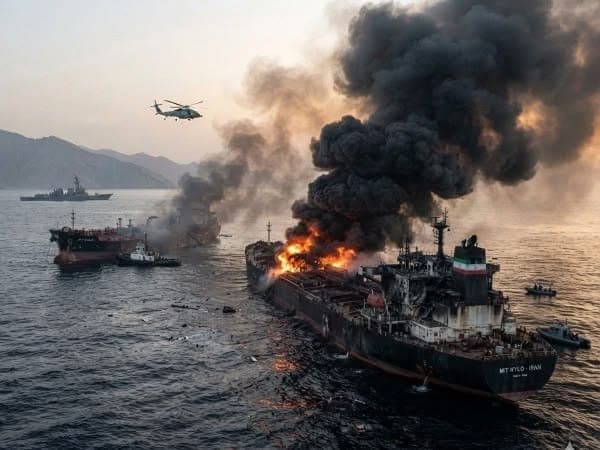
Iran has intensified its attacks on commercial vessels in the Strait of Hormuz, recording more than 35 maritime incidents in October as Tehran steps up efforts to disrupt oil shipments through the strategic waterway.
The attacks, which have extended beyond oil tankers to container ships, bulk carriers and gas vessels, form part of an expanding campaign involving underwater drones, sea mines and small boats, according to a Wall Street Journal report published on Wednesday.
Iran is increasingly relying on unconventional maritime operations to target individual vessels and undermine the security of commercial shipping, following significant losses to its conventional naval forces during the conflict with the United States.
The tactics include deploying bomb-carrying underwater drones, attaching limpet mines to ships using small boats and firing rocket-propelled grenades at commercial vessels.
The United Kingdom Maritime Trade Operations (UKMTO) centre recorded more than 35 incidents in October, the highest monthly figure since the conflict began. At least five additional vessels were reportedly attacked in November.
One of the recent incidents occurred on October 30, when a tanker was struck by two limpet mines near Oman's Khasab, causing an engine-room fire and temporarily disabling the vessel. The crew escaped unharmed, according to UKMTO.
Iran has also reportedly expanded its surveillance methods, using civilian vessels and human spotters to monitor shipping movements and relay information to missile and drone operators.
The development comes as the United States maintains naval patrols and operations to facilitate commercial vessel movements through the strait, while enforcing a blockade of Iranian ports.
Washington has maintained that the waterway is under its control and that Iranian mines have been cleared. However, the continued attacks have raised fresh concerns over the safety of vessels transporting crude oil and petroleum products through the route.
Data from ship-tracking firm Kpler showed that oil flows through the Strait of Hormuz, including associated ship-to-ship transfers, averaged approximately 7.8 million barrels per day in the week ending November 1.
The volume represents about 45 per cent of pre-war levels, following a recovery in shipments earlier in October.
The disruption has also increased the cost of transporting crude oil from the Persian Gulf to international markets.
According to the International Energy Agency (IEA), the cost of shipping crude from the Gulf to Asia approached $37 per barrel in mid-October, more than five times its pre-conflict level.
Meanwhile, Brent crude traded around $102 per barrel on Tuesday, as developments in the US-Iran conflict continued to influence market conditions.