

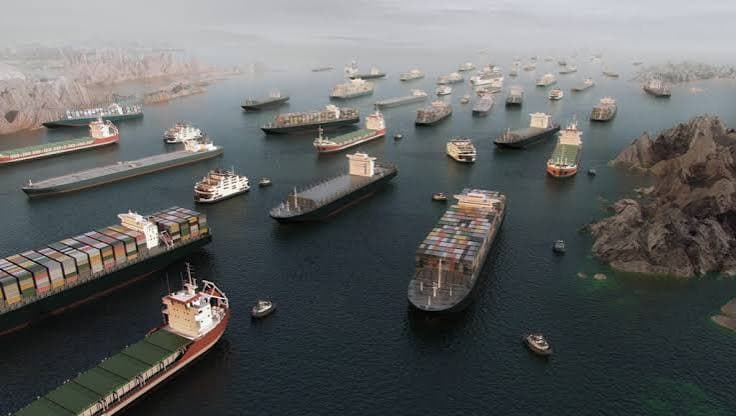
Tanker movements through the Strait of Hormuz fell to their lowest level in five weeks on Sunday as renewed military exchanges between the United States and Iran heightened security concerns across one of the world's busiest energy shipping corridors.
Shipping intelligence firm Kpler tracked only six tankers transiting the strategic waterway on Sunday, marking the weakest daily traffic since early June. Early indications on Monday also suggested no vessels were attempting to pass through the strait, with no commercial ships visible on Automatic Identification System (AIS) tracking platforms.
The sharp decline followed a fresh escalation in the conflict after the United States launched a third round of strikes against Iranian targets. Iran responded by attacking U.S. military facilities and allied locations in Kuwait, Bahrain, Qatar, Oman and Jordan, further increasing uncertainty over the safety of commercial shipping.
The limited traffic recorded on Sunday included a supertanker transporting Iranian crude, a tanker carrying refined petroleum products from Kuwait and three empty tankers entering the Persian Gulf to load crude from regional export terminals.
Notably, no liquefied natural gas (LNG) carriers were recorded passing through the Strait of Hormuz during the weekend, according to Kpler data.
The deteriorating security environment has also prompted many vessel operators to once again switch off their AIS transponders while navigating the waterway, making their movements difficult to detect. The practice, commonly referred to as operating in "dark mode," has resurfaced following last week's attacks on commercial vessels and the latest military escalation.
The return of dark mode voyages marks a reversal from the period following the signing of the U.S.-Iran memorandum of understanding, when tanker and LNG traffic had gradually recovered, and more vessels resumed transiting the strait with their tracking systems active.
Maritime intelligence company Windward said multi-source monitoring of the eastern approaches to the Strait of Hormuz identified eight vessels operating without AIS transmissions on July 12.
According to the firm, two of the unidentified vessels appeared to be conducting a ship-to-ship transfer off the coast of the United Arab Emirates and Oman, while four additional dark vessels were tracked heading toward the Gulf. Another vessel was observed remaining stationary in the area, a development Windward said had not previously been recorded.
The renewed decline in tanker movements highlights growing caution among shipowners as security risks continue to rise around the Strait of Hormuz, a maritime chokepoint that handles roughly one-fifth of global oil and liquefied natural gas shipments. With tensions between Washington and Tehran showing few signs of easing, market participants are closely monitoring vessel traffic for indications of further disruption to global energy supplies.