

Nigeria is facing a persistent and devastating threat to its oil industry: pipeline vandalism. The country has long struggled with a toxic mix of crude theft, sabotage, and illicit refining, an ecosystem so entrenched that analysts say it can’t be dismantled by force alone.
Since 2002, more than 353 million barrels of crude oil—worth an estimated $25.7 billion have been stolen from pipelines in the Niger Delta, according to figures from Nigeria’s upstream oil regulator. The scale is staggering: the losses amount to nearly three-quarters of Nigeria’s entire 2025 federal budget.
Even after high-profile crackdowns by military and security forces, the problem persists. By May 2025, Nigeria was still losing roughly 11,100 barrels of oil per day to theft. That’s despite a wave of security operations, aggressive arrests, and billions of naira spent protecting pipeline assets.
Yet the deeper question remains: why does the sabotage persist, and why has Nigeria failed to stamp it out after decades of interventions?
Rooted in Poverty, Grievance, and Greed
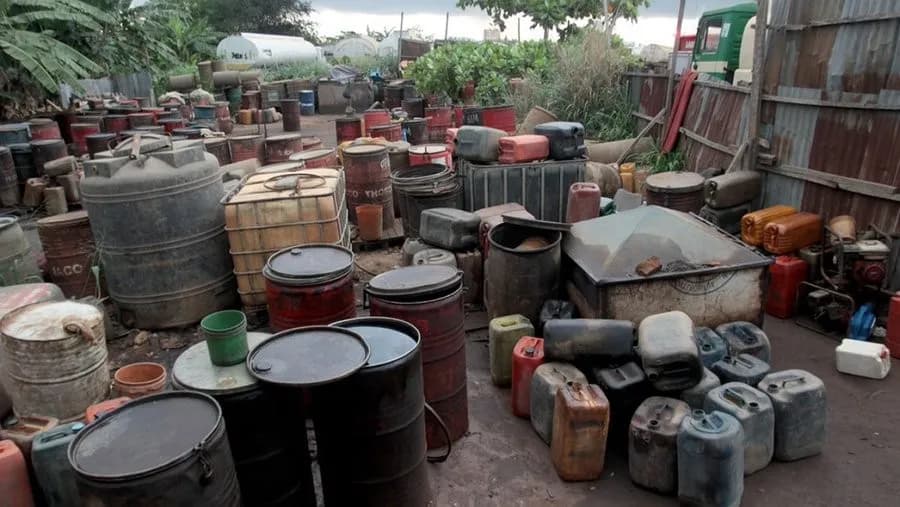
Experts say the drivers of pipeline vandalism are both economic and political. In the impoverished communities of the Niger Delta, where the bulk of Nigeria’s oil is extracted, unemployment remains alarmingly high. Many local residents, particularly young men, have few options beyond participating in the illegal oil trade. Crude is tapped from pipelines and refined in rudimentary facilities known as “artisanal refineries,” with the product sold on the black market or smuggled abroad.
For some, it’s a matter of survival. For others, it’s payback.
Years of environmental degradation—from oil spills, gas flaring, and broken development promises—have left local populations embittered. Decades of neglect and the perception that oil wealth benefits Abuja and foreign firms while polluting their creeks and farmlands have created what experts call a “pollution grievance economy.” Sabotaging pipelines, in this view, becomes both an economic necessity and a political statement.
Overlaying this is a more sinister element: organized crime. Oil theft in Nigeria is no longer just the domain of local operators. It is widely believed to involve high-level actors—insiders within the industry, powerful financiers, and even elements of the political class. In 2024, lawmakers estimated that up to 400,000 barrels per day were being siphoned off through criminal networks. Although official losses have since fallen, the involvement of elite sponsors continues to frustrate enforcement.
Military Gains, But Limits Remain
To its credit, the Nigerian government has made some progress. The military-led Joint Task Force (JTF) and operations such as Delta Safe and Whirlwind have dismantled hundreds of illegal refineries, intercepted millions of litres of stolen crude, and arrested hundreds of suspects in the past year alone. These efforts have contributed to a marked rebound in oil production—from roughly 1.2 million barrels per day in mid-2024 to 1.85 million by May 2025. Pipeline “uptime,” once crippled by sabotage, has reached historic highs. NNPC announced 100% availability on key pipelines for June 2025—an unheard-of figure during Nigeria’s worst vandalism years.
However, these victories may prove short-lived if deeper issues are not addressed. Security operations are expensive—the NNPC has spent an average of ₦16 billion ($11 million) per month on pipeline protection. Yet vandalism persists. Industry insiders acknowledge that over 1,000 illegal taps remain active and that new ones appear almost daily. Arrests and raids treat the symptoms but leave the root disease untouched.
There is also the risk of alienating local communities. Heavy-handed raids can turn communities against authorities, pushing young people further into the arms of criminal networks. “You cannot militarize a poverty problem,” one regional analyst told PetroleumPrice.ng. “Force can disrupt, but it cannot transform.”
Building a Multi-layered Response
That insight is now driving calls for a more holistic, multi-pronged solution. Experts argue that addressing pipeline sabotage requires more than security—it demands a mix of economic investment, community engagement, infrastructure renewal, technology deployment, and legal reform.
Some of these strategies are already showing results. A notable example is Pipeline Infrastructure Nigeria Limited (PINL), a private operator managing a major pipeline corridor in the Delta. Rather than relying solely on armed guards, PINL has embedded itself within host communities—offering over 600 scholarships, running skills programs for women, and partnering with local chiefs and youth leaders. The result? Fewer incidents and more community cooperation. In fact, the NNPC credited such local partnerships for the dramatic improvements in pipeline availability by mid-2025.
International models offer further proof. In Mexico, Colombia, and parts of West Africa, governments have combined high-tech surveillance (drones, leak detection, satellite imaging) with social investments to reduce pipeline sabotage. Nigeria has begun adopting similar tools: the NNPC recently partnered with a European tech firm to monitor pipelines using AI and satellite data. In one case, 450 illegal intrusions were detected within three months—many before any damage occurred.
What Still Needs to Be Done
However, infrastructure and surveillance alone are not enough. Nigeria must also pursue:
- Legal reform to ensure oil theft cases lead to convictions—not just arrests.
- Transparent reporting, so the scale of the problem stays in public view and builds accountability.
- Cross-border cooperation, since smuggled oil often leaves through neighboring countries.
- Reform of institutions like the Niger Delta Development Commission (NDDC), which have been dogged by corruption and poor delivery.
Perhaps most importantly, Nigeria must begin to transition away from crude dependency altogether. Expanding refining capacity, investing in gas and renewable energy, and accelerating economic diversification would reduce the incentive to sabotage pipelines in the first place.
The Path Forward
Pipeline vandalism in Nigeria is more than a law enforcement issue. It is a reflection of failed promises, economic desperation, and elite impunity. Recent security gains are real and commendable, but they are not sustainable without parallel reforms.
To finally break the cycle, Nigeria must move from containment to transformation—building trust with local communities, modernizing infrastructure, and confronting the political economy that enables oil theft at scale. When pipeline security becomes a shared interest—rather than a battlefield—the sabotage economy may finally begin to recede.