

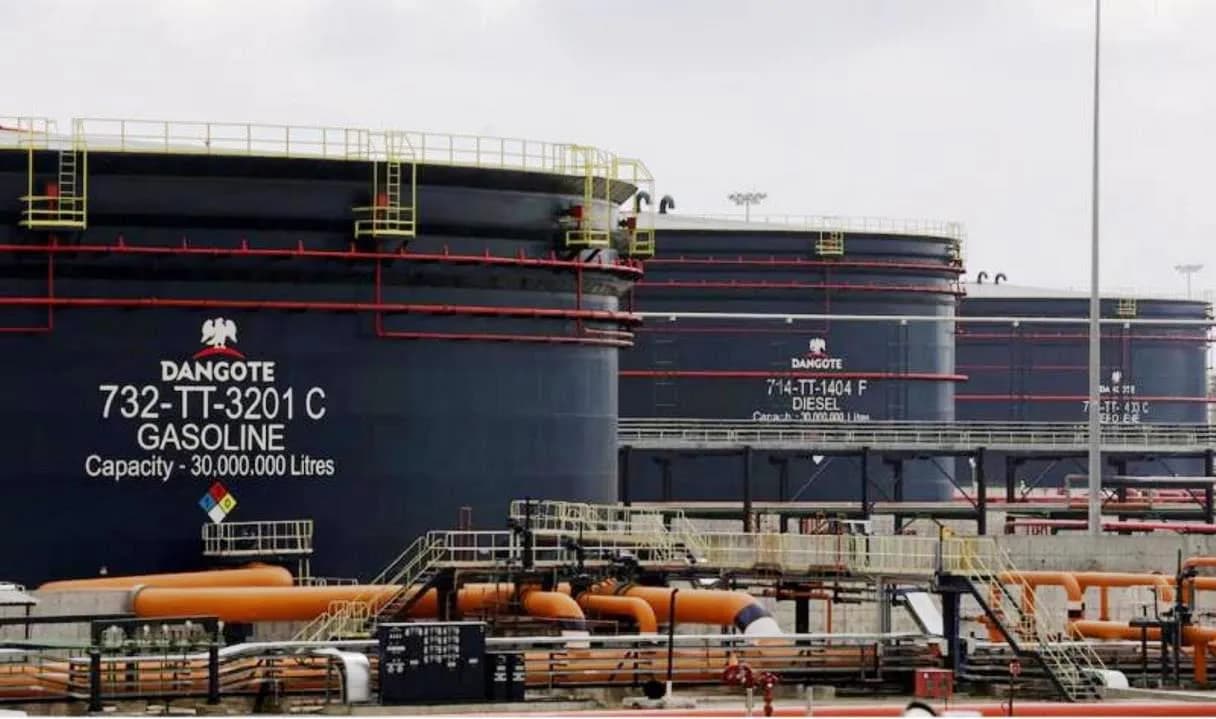
President Bola Tinubu visited the Dangote Refinery in Lekki, Lagos, on Thursday. This marks his first official tour of the $20 billion facility since it began operations in 2024.
The visit signals strong government support for local refining and reduced fuel importation.
The 650,000 barrels-per-day refinery is Africa’s largest and is owned by Aliko Dangote.
The refinery aims to transform Nigeria’s fuel supply chain and boost energy independence. President Tinubu praised the refinery’s scale and called it a major investment in Nigeria’s future.
“Aliko, I commend your belief in Nigeria,” Tinubu said during the visit.
Analysts see this visit as a sign of renewed policy support for local refining.
They believe this could stabilise operations and reduce foreign exchange pressure.
Strategic Shift in Energy Policy
The refinery began processing crude oil into fuel products in 2024. It produces diesel, gasoline, jet fuel, and other refined products.
Nigeria recently lost its top fuel importer status to South Africa.
This shift is due to the Dangote Refinery’s impact on local supply. Around 400,000 barrels are processed daily, with 35% of crude sourced internationally. Crude is imported from the U.S., Angola, Brazil, and Equatorial Guinea.
Supply issues have limited local crude availability for the refinery.
The naira-for-crude policy initially addressed this challenge.
President Tinubu introduced the policy in July 2024.
It allowed refineries to buy crude using naira instead of dollars.
This helped conserve foreign reserves and stabilise fuel prices.
However, the policy expired in March 2025.
Its non-renewal raised fears of fuel price hikes. The President’s visit is seen as a sign of possible policy reinstatement.
A similar intervention could help maintain steady operations.
Ending Fuel Queues
During the visit, Aliko Dangote addressed the refinery’s national impact.
He claimed the fuel shortage and long queues have now ended.
“Fuel stations are back in business,” Dangote declared. He promised shortages would not return. To honour the President’s support, Dangote named the refinery’s road after Tinubu.
This move symbolises stronger collaboration between government and private industry. Dangote thanked Tinubu for supporting local industrial efforts.
Fuel Security and Economic Benefits
The refinery operates at 85% capacity.
Full 650,000 bpd output is expected by mid-2025. This will cover Nigeria’s refined fuel needs completely.
It will also produce a surplus for export.
Experts say this could save Nigeria billions in import costs annually.
The refinery’s output helps stabilise the naira and reduce dollar demand. It also reduces fuel import dependency significantly.
Petrochemical Growth and Exports
The refinery recently partnered with Vinmar Group to export polypropylene.
Nigeria currently imports 90% of its polypropylene needs.
This deal could make Nigeria a net exporter of petrochemicals.
Jet fuel from the refinery now reaches North American markets. In March 2025, U.S. jet fuel imports hit a two-year high.
Dangote’s exports contributed to this rise.
This highlights Nigeria’s growing influence in global fuel markets.
Challenges and Industry Frictions
Despite progress, the refinery still faces challenges. Local crude supply remains inconsistent. Oil cartels resist changes like subsidy removal and market reforms.
Dangote criticised these groups for stalling sector progress. The naira-for-crude policy faced opposition from vested interests.
Recent tensions with the NNPCL affected refinery operations.
Tinubu’s administration intervened to resolve these issues. New leadership at NNPCL has improved cooperation. An NNPCL official praised Dangote’s long-term investment in Africa.
A Broader Energy Vision
Tinubu’s visit aligns with broader energy reforms. The government aims to revive local refineries. Crude oil drilling in northern Nigeria is also a priority.
Naming the road after Tinubu highlights national commitment to energy development. Dangote said the refinery represents national pride and resilience.
Navigating Economic Pressures
The naira continues to face depreciation.
Global oil prices have dropped significantly since 2024. Nigeria’s budget was based on $75 per barrel. Oil now trades around $65 per barrel. This could lead to a wider budget deficit.
Analysts warn of reduced revenue if prices remain low.
Nonetheless, local production continues to grow. Tinubu’s visit may encourage more government support. It could help secure crude supplies for the refinery.
Experts believe the refinery will meet national needs and boost exports.
With government backing, full capacity may be reached soon.