

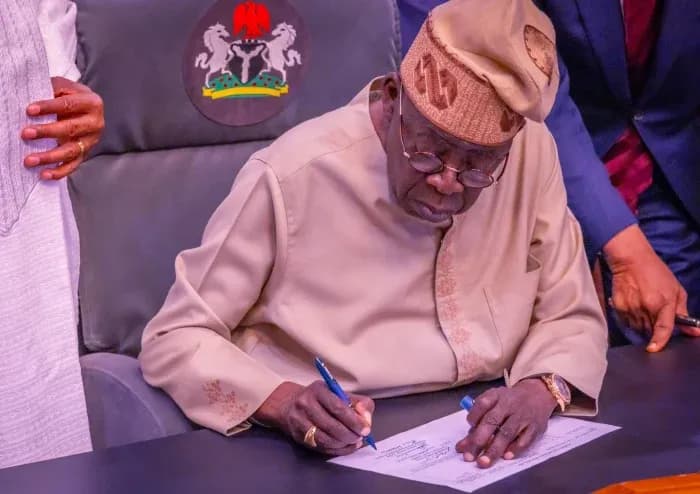
President Bola Ahmed Tinubu has signed an Executive Order mandating the direct remittance of oil and gas revenues to the Federation Account, in what may become one of the most consequential fiscal reforms since the Petroleum Industry Act (PIA) took effect. The directive aims to curb revenue leakages, eliminate duplicative deductions and restore constitutional allocations to the federal, state and local governments.
Anchored on Sections 5 and 44(3) of the Constitution, the order reasserts federal ownership and control over mineral resources. More importantly, it confronts structural provisions within the PIA that, according to the Presidency, have significantly reduced net inflows to the Federation Account through multiple layers of deductions.
Ending Multiple Deductions Under the PIA
Under the existing framework, the Nigerian National Petroleum Company Limited retains 30 per cent of profit oil and profit gas as a management fee under production and profit-sharing contracts. In addition, the company keeps 20 per cent of its profits for working capital and future investments. The Federal Government now considers the additional 30 per cent management retention unjustified, arguing that the 20 per cent retained earnings are sufficient for operational needs.
Additionally, the government had allocated 30 per cent of profit oil and profit gas to the Frontier Exploration Fund under Sections 9(4) and (5) of the PIA. The Executive Order now redirects that 30 per cent straight to the Federation Account. From February 13, 2026, operators under production sharing contracts must also pay Royalty Oil, Tax Oil, Profit Oil and Profit Gas directly into the Federation Account.
The President also suspended payments of gas flare penalties into the Midstream and Downstream Gas Infrastructure Fund. Going forward, such penalties will be paid directly into the Federation Account, while expenditure from the gas infrastructure fund must comply strictly with public procurement regulations.
Repositioning NNPCL as a Commercial Entity
Beyond revenue redirection, the order addresses structural overlaps within the PIA. The President raised concerns about NNPCL’s dual role as both concessionaire and commercial operator, warning that this arrangement creates potential cost distortions and weakens transparency. Consequently, the Executive Order seeks to reposition NNPCL strictly as a commercial enterprise while safeguarding the Federation’s fiscal interests.
To ensure effective implementation, President Tinubu approved the establishment of an inter-ministerial committee comprising the Minister of Finance, the Attorney-General of the Federation, the Minister of Budget and Economic Planning, the Minister of State for Petroleum Resources (Oil), and other key officials. The committee will oversee coordinated enforcement and compliance across the sector.
Ultimately, this reform directly targets declining net oil revenue inflows and mounting fiscal pressure. If fully enforced, the policy could significantly boost Federation Account remittances, strengthen subnational allocations and improve debt sustainability. However, its success will depend on transparent execution and sustained regulatory discipline within Nigeria’s oil and gas architecture.