

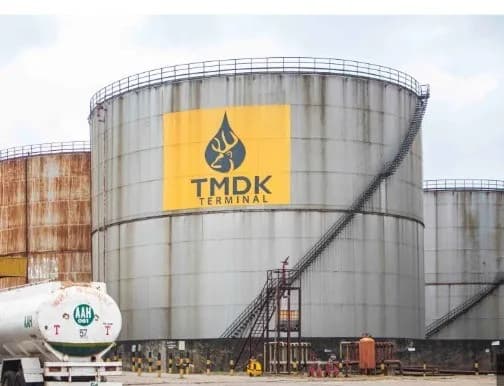
TMDK Terminal has strongly opposed the shutdown of its depot in Ijegun-Egba by the Nigerian Maritime Administration and Safety Agency (NIMASA), describing the operation as hostile, intimidating, and procedurally flawed. The company also alleged extortion attempts by officials involved in the enforcement, citing an informal demand of $20,000 and threats of $50,000 in daily demurrage if they failed to comply.
The depot, which operates alongside ShellPlux and shares jetty access with other facilities, was sealed on July 14, 2025. NIMASA justified the closure under Section 79(f) of the 2014 ISPS Implementation Regulations, which mandates a shutdown for facilities that fail to resolve security violations within three months.
TMDK, however, disputes both the targeting and the procedure of the enforcement.
TMDK: “This Was Intimidation, Not Regulation”
In an exclusive interview with Petroleumprice.ng, Mr. Ahmed Suleiman Leda, CEO of TMDK Terminal Limited, criticized the enforcement as aggressive and lacking due process. He said armed personnel stormed the facility without prior notice, ejected workers, and disrupted operations despite significant safety risks.
“They arrived with truckloads of armed men and forced everyone out, including other regulatory agencies’ representatives in the facility,” he said. “With over 50 million litres of diesel and loaded tankers on-site, such force was reckless. This created panic.”
According to an internal incident report, NIMASA officials arrived at No. 1 Pioneer Drive, off Marwa Road, Ijegun-Egba, around 10:35 am on July 16, 2025. Accompanied by uniformed naval personnel, they ordered an immediate halt to all operations.
TMDK management informed them that the MT ELLIEM II vessel was docked and that suspending operations would result in a $50,000 demurrage fee. Despite this, the officials insisted on halting activities and referred management to a contact named “Muri.” When reached, Muri refused to speak over the phone and demanded an in-person meeting.
Attempts to resolve the issue failed. Armed personnel remained at all access points of the facility and jetty for nearly 24 hours before leaving at approximately 8:45 am on July 17, 2025.
Regulatory Tensions and Disputed Jurisdiction
TMDK argues that its facility functions strictly as a depot, not a jetty, and therefore falls outside NIMASA’s direct regulatory oversight. The company also claims it received no formal invitation or warning prior to the enforcement action. It maintains that its operations comply with all standards set by the Nigerian Midstream and Downstream Petroleum Regulatory Authority (NMDPRA).
“There was no communication, no hearing—just brute enforcement,” Mr. Ahmed said. “We’re legitimate business people. We refuse to operate under blackmail.”
NIMASA stands by its decision. A notice signed by Mr. Mudi I. Isa, Head of the agency’s ISPS Unit, stated that ShellPlux and TMDK repeatedly failed to implement ISPS security protocols, warranting the closure.
Director General Dr. Dayo Mobereola has defended the action, asserting that it complies with global maritime safety standards and supports Nigeria’s bid to lift U.S. Coast Guard restrictions.
Legal Threats, Extortion Allegations, and Next Steps
TMDK has accused enforcement officials of attempting to extort money during the closure. Mr. Ahmed alleged that a representative demanded $20,000 to resolve the matter and warned that failure to settle would lead to daily demurrage charges of $50,000. He insists that the depot, not the jetty, is TMDK’s only asset and that the jetty belongs to Ecobank, which inherited it from a defaulting debtor.
“They didn’t go to other depots using the same jetty, only ours,” Mr. Ahmed claimed. “It was clearly a tactic to force a settlement, but we will not negotiate under threats.”
TMDK is reviewing its regulatory obligations and will act accordingly. We won’t join issues with NIMASA, but for clarity, we own a depot, not a jetty. Depots aren’t under NIMASA’s supervision; their responsibility lies with the waterways.
“We’re open to dialogue if the proper channels are followed,” said Ahmed. “But we won’t bow to intimidation.”
As the conflict unfolds, the oil and gas sector is watching closely. The case could influence how regulatory agencies enforce compliance and whether businesses can operate without fear of arbitrary clampdowns.