

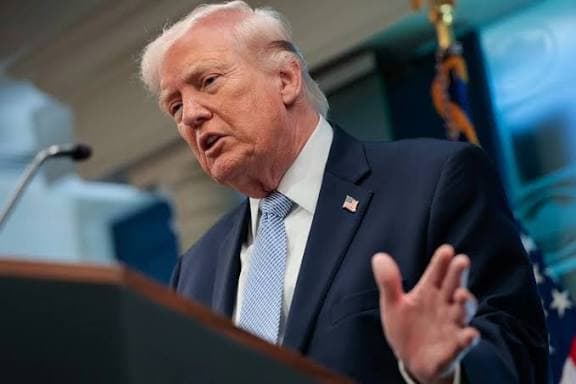
U.S. President Donald Trump on Monday declared that the United States would assume the role of "guardian" of the Strait of Hormuz and impose a 20 percent charge on cargoes transiting the strategic waterway, marking a significant escalation in Washington's response to the ongoing dispute with Iran over control of one of the world's most critical energy corridors.
The announcement follows renewed military exchanges between the United States and Iran that have further complicated negotiations aimed at ending the conflict and restoring unrestricted navigation through the strait.
In a statement posted on his Truth Social platform, Trump said the United States was reinstating what he described as the "Iranian blockade," explaining that the measure would restrict only Iranian vessels and ships transporting Iranian cargo while allowing all other countries to continue using the waterway.
"The Hormuz Strait is OPEN, and will remain OPEN, with or without Iran," Trump said.
"We are reinstating the THE IRANIAN BLOCKADE, so named because it is only stopping Iran's ships or customers from entering or leaving. All other countries will have fair and open use of the Strait."
Trump also announced that the United States would begin collecting a 20 percent charge on cargoes moving through the passage, saying the proceeds would cover the cost of maintaining security along the volatile maritime route.
"The U.S.A. will, from this point forward, be known as 'THE GUARDIAN OF THE HORMUZ STRAIT'... and will be reimbursed, at the rate of 20% on all cargo shipped, for any and all costs necessary to provide safety and security," he wrote.
Before the conflict began on February 28, commercial vessels moved freely through the Strait of Hormuz, which carries roughly one fifth of global crude oil and liquefied natural gas supplies. Since the outbreak of the war following U.S. and Israeli strikes on Iran, however, Tehran has repeatedly asserted control over the waterway, insisting that vessels comply with navigation routes designated by Iranian authorities.
The latest escalation followed Sunday's attack on a commercial container ship in the strait, which the United States accused Iran of deliberately targeting. The incident prompted fresh U.S. airstrikes against Iranian military infrastructure, while Iran retaliated with missile and drone attacks targeting U.S. military facilities and allied countries across the Gulf region.
The exchange has further undermined efforts to implement the memorandum of understanding signed last month, under which both countries agreed to pursue a 60 day negotiation process covering Iran's nuclear programme, maritime security and broader regional stability.
A major point of disagreement remains the administration of the Strait of Hormuz.
Iran maintains that the interim agreement allows it to regulate shipping through the waterway and require vessels to follow Iranian approved transit routes. The United States rejects that interpretation, insisting the agreement guarantees unrestricted international navigation and that Tehran has violated its commitments by repeatedly attacking commercial vessels.
Iranian military officials have warned they will not permit the United States or its allies to interfere in what they describe as Iran's management of the strait, adding that any unauthorized military presence or support for U.S. operations would be regarded as hostile action.
Despite the heightened tensions, both Washington and Tehran have indicated they remain open to negotiations, although repeated attacks around the strait continue to cast doubt over the prospects for a lasting agreement.
The renewed uncertainty has also affected maritime traffic through the corridor, with shipping intelligence firms reporting a sharp decline in commercial vessel movements as operators weigh the growing security risks associated with one of the world's busiest energy shipping routes.