

US President Donald Trump has said the United States could reach a deal with Iran after the November midterm elections, while warning that Washington is also considering further military action if an agreement is not reached.
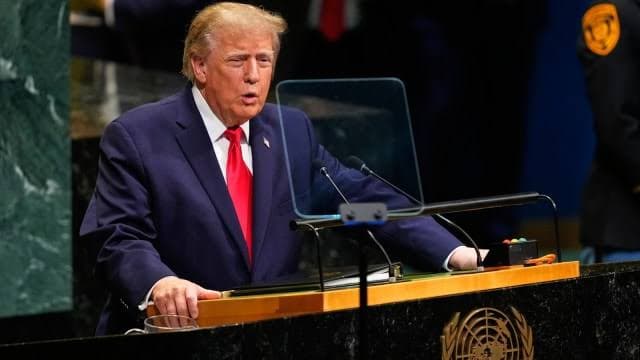
Trump made the remarks on Tuesday, September 22, 2026, during his address to the 81st United Nations General Assembly in New York, where he defended the ongoing US conflict with Iran and said preventing Tehran from developing a nuclear weapon remained a key objective.
“I believe we’ll make a deal right after the election because it doesn’t make sense for them not to,” Trump said, adding that Iran was waiting to see how his Republican Party performs in the November elections.
Trump said he was not personally contesting the election, having already won what he described as a landslide victory, but suggested Tehran could be assessing the political outlook in Washington before committing to an agreement.
The president also presented further military action as an alternative to a negotiated settlement, saying he faced a major decision over whether Iran would be allowed to rebuild or face additional US action.
Trump said any agreement must ensure that Iran never acquires a nuclear weapon, which he described as the central issue that prompted the US to confront Tehran.
His comments came as diplomatic activity around the conflict continued, with an Iranian delegation in New York for the UN General Assembly and discussions over possible avenues for de-escalation.
Iran has separately indicated that it could reopen the Strait of Hormuz within a week if Washington eases military pressure and lifts its blockade of Iranian ports. Tehran has also warned that it would retaliate against US and allied positions if attacked.
The prospect of diplomacy has taken on wider significance for global energy markets because the conflict has disrupted crude flows through the Strait of Hormuz, a key route for international oil shipments.
Oil prices fell on Tuesday as traders assessed the possibility of renewed US-Iran diplomacy alongside signs that Saudi Arabia was restoring some disrupted crude-export capacity.
Trump also used his UN address to highlight other foreign policy priorities, including his administration’s efforts to advance a 20-point Gaza peace plan and its wider approach to international conflicts.
The US president is expected to hold meetings with several world leaders on the sidelines of the UN gathering, as Washington continues to weigh diplomatic engagement against military and economic pressure on Iran.
For the oil market, the timing and outcome of any US-Iran agreement could remain significant, particularly if a diplomatic breakthrough leads to reduced restrictions on Iranian energy exports or improves shipping conditions around the Strait of Hormuz.