

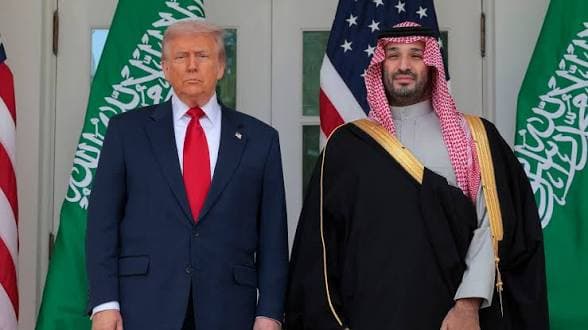
President Donald Trump has signalled that the United States is approaching a critical decision over the next phase of its war with Iran, as Washington simultaneously advances a potential $24.3 billion sale of F-35 fighter jets to Saudi Arabia and Tehran continues reinforcing a deeply buried nuclear-linked facility.
Trump told Axios that he was facing what he described as a “big decision” over whether to intensify the conflict, including the possibility of launching further attacks against Iran’s leadership.
“I have a big decision coming up,” Trump said, adding that he was weighing whether to “annihilate” the Iranian regime or take another course.
The remarks came ahead of Trump’s planned meetings with leaders of six Gulf Arab states; Saudi Arabia, the United Arab Emirates, Qatar, Bahrain, Kuwait and Oman, on the sidelines of the United Nations General Assembly in New York next week. The discussions are expected to address the war and Washington’s next steps.
At the same time, the United States has moved to strengthen Saudi Arabia’s military capabilities, with the State Department approving a potential sale of 48 F-35 Lightning II fighter aircraft and related equipment to Riyadh.
The proposed deal, valued at about $24.3 billion, still requires congressional review. The package includes the advanced fighter aircraft and associated equipment, with the State Department saying the proposed sale would support US security objectives in the Gulf.
The development comes as Saudi Arabia confronts an intensifying conflict with Yemen’s Iran-aligned Houthi movement. The Houthis have claimed that Saudi forces carried out 26 strikes against areas under their control within a 24-hour period, bringing their claimed total to 300 Saudi strikes over the previous week. Those figures have not been independently verified.
The fighting has expanded along Yemen’s Red Sea coast, including areas around the strategically important Bab el-Mandeb Strait. The renewed offensive has also displaced more than 115,000 people, according to Reuters, with the Houthis making territorial gains and Saudi-backed forces attempting to regain ground.
While Washington weighs its broader response to Tehran, fresh satellite imagery has highlighted increased defensive construction at Iran’s Pickaxe Mountain complex near Natanz.
Analysis by the Center for Strategic and International Studies found a surge in construction activity at the deeply buried site during 2026, including hardened portal entrances, reinforced access areas, improved roads and the removal of excavation spoil. The analysis said the activity appeared to indicate a transition from excavation towards probable internal construction, although it could not establish whether Iran had moved nuclear centrifuges into the facility.
A separate analysis by the Institute for Science and International Security found that Iran had placed earthen barriers across roads leading to western tunnel entrances at Pickaxe Mountain. The barriers were visible in satellite imagery from August and remained in place in September, potentially restricting vehicle access to the underground complex.
The site has attracted particular attention because of its depth and hardened construction. Trump has repeatedly threatened to strike the facility, while analysts have described any attempt to destroy it as a significant military and targeting challenge.
The pressure on Tehran is also extending into the financial sphere. The US State Department’s Rewards for Justice programme is offering up to $15 million for information that could disrupt the financial mechanisms of Iran’s Islamic Revolutionary Guard Corps and its Quds Force, including information on revenue sources, financial facilitators, front companies and sanctions-evasion networks.
Trump on Friday also signed the Lindsey O. Graham Sanctioning Russia and Iran Act of 2026 into law. The legislation expands sanctions authorities targeting Russia while extending the Iran Sanctions Act for another five years. It also gives the president authority to impose tariffs of up to 100% on major importers of Russian oil and natural gas.
The US administration has, however, left open a diplomatic channel with Tehran. Washington has approved visas for Iranian President Masoud Pezeshkian, Foreign Minister Abbas Araghchi and other members of Iran’s core delegation to attend next week’s UN General Assembly in New York.
The decision was made despite the ongoing war and was linked by the State Department to US obligations as host country of the United Nations. The Iranian delegation is expected to be smaller than in previous years and will face restrictions on movement and certain purchases while in the United States.
Trump is also expected to put Iran’s nuclear programme at the centre of his address to the UN General Assembly. US Ambassador to the United Nations Mike Waltz said the president would argue that Iran must be prevented from obtaining a nuclear weapon, while also discussing the administration’s efforts to advance a peace plan for Gaza.
China is meanwhile pressing Washington and Tehran to return to negotiations. Chinese Foreign Minister Wang Yi told Araghchi during talks in Beijing on September 16 that China was prepared to play a “constructive role” in resolving international disputes and urged the United States and Iran to rebuild their negotiating mechanism and hold substantive consultations on outstanding issues.
Araghchi said after the meeting that decisions made in consultation with China could have major consequences for the strategic balance in the region. The discussions came ahead of a planned meeting between Chinese President Xi Jinping and Trump in Washington next week.
The pressure on Iran is also being felt through its regional financial networks. Turkey’s banking regulator has revoked the operating licence of Bank Mellat’s Istanbul branch, according to a decision published in the country’s Official Gazette. The regulator cited provisions of Turkish banking law concerning risks to depositors and the stability of the financial system; the decision was not publicly tied to a specific US sanctions action.
With military pressure, sanctions, diplomatic manoeuvring and the wider Yemen conflict developing simultaneously, Trump’s forthcoming discussions with Gulf leaders and his UN address are set to provide further indications of how Washington intends to proceed in the Iran war.
For now, Trump has indicated that a major decision is approaching, while both the military and diplomatic tracks remain active.