

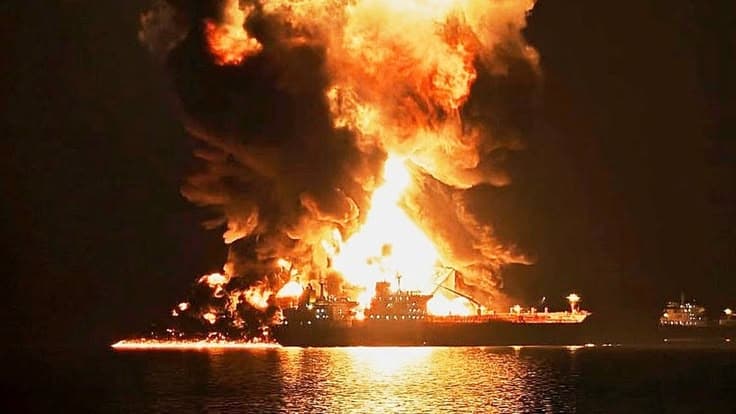
The United States and Iran have traded strikes after three oil tankers were hit in the Strait of Hormuz, the second such exchange between the two countries in as many weeks.
Three tankers were struck by projectiles on Tuesday, the British military said. The Qatari owned liquefied natural gas tanker Al Rekayyat was hit roughly eight miles east of Limah, Oman, sparking a fire in its engine room, though no casualties were reported. A Saudi flagged crude oil supertanker, the Wadyan, was also damaged. A separate tanker was struck as it exited the strait near the Omani-Emirati border, while a third vessel was hit by a drone off the coast of Oman, sustaining minor structural damage. All three ships appeared to have been using a route close to Oman's coast rather than the passage endorsed by Tehran. Iran has not directly claimed responsibility for the attacks.
US Central Command said it had responded on Tuesday with strikes on more than 80 targets inside Iran, hitting Qeshm island, Bandar Abbas and Sirik. It said the operation targeted air defences, radar sites, anti-ship missile sites and dozens of small boats used by Iran's Revolutionary Guard Corps, and was intended to impose costs for attacks on commercial shipping crewed by civilians. Iranian media reported that a strike on Sirik sent several people to hospital, and said most of the sites hit across the region were civilian, including fishing piers and a telecommunications tower.
Iran's Revolutionary Guard Corps said on Wednesday it had retaliated by targeting 85 US military installations in Bahrain and Kuwait, in response to the US strikes on its Hormozgan province and the port city of Mahshahr. It said the operation hit facilities including a US Navy headquarters in Bahrain and an air base in Kuwait. Air raid sirens sounded in both countries. Kuwait said it was under attack from Iranian drones and missiles and condemned what it called repeated aggression. The US did not reimpose the naval blockade on Iran it had lifted under last month's memorandum of understanding.
Qatar's foreign ministry said it held Iran fully responsible for an attack it described as a "serious and explicit violation of international law." Saudi Arabia's foreign ministry described the strike on the Wadyan as "an assault on the security and safety of international navigation, and on the security of global energy supplies." Iran's foreign ministry spokesman said commercial vessels using routes not co-ordinated with Tehran, or tampering with tracking systems, faced a risk of collision.
Nato secretary general Mark Rutte said the American strikes were "absolutely necessary," speaking as the alliance opened a summit in Ankara, and argued that Iran had violated the ceasefire given the attacks on shipping. Iran's parliamentary speaker, Mohammad Bagher Ghalibaf, rejected the accusation, accusing the US instead of breaching the memorandum through its strikes, its reinstated sanctions and what he called violations of Iranian adjustments in the strait.
Before the US strikes, the Treasury Department revoked a licence that had authorised Iran to sell oil and petrochemicals on the international market, a measure that had formed part of the memorandum of understanding signed by Washington and Tehran last month. The sanctions are due to be reimposed from 17 July. Iran's foreign ministry called the revocation a breach of the agreement. Under the same memorandum, Iran and Oman were due to hold talks with other Gulf states on the future administration of the strait, through which about a quarter of the world's seaborne oil trade and a fifth of its liquefied natural gas normally passes.
Brent crude rose 3.14 per cent on Wednesday to $76.49 a barrel, while West Texas Intermediate rose 3.07 per cent to $72.61 a barrel, as markets reacted to the fresh strikes and the threat to shipping through the strait.