

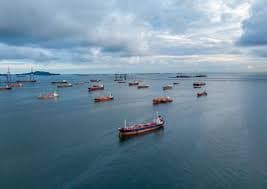
The United States has made progress in reopening the Strait of Hormuz, but the wider conflict with Iran remains unresolved, with continued military tensions keeping a major source of uncertainty over global oil supply.
The development is significant for the oil market because the Strait of Hormuz carries about one-fifth of the world’s traded oil and gas during normal conditions. Iran effectively closed the strategic waterway in the early stages of the war, using the disruption as leverage while continuing to export its own crude, mainly to China.
That position has since weakened. According to figures compiled by oil expert Homayoun Falakshahi of Kpler, Iran’s oil exports fell from 1.85 million barrels per day last spring to about 255,000 bpd in August, while exports of non-Iranian oil through the strait and alternative routes increased substantially.
Non-Iranian oil exports rose from about 300,000 bpd at the height of the conflict to 8.4 million bpd in September, reaching 10.8 million bpd when alternative routes were included. US Energy Secretary Chris Wright said the flows had recovered to roughly two-thirds or more of pre-conflict levels.
Despite the improvement in flows, the recovery has come at a significant military and economic cost. The United States has maintained a major military deployment around the strait to facilitate the movement of Gulf oil, placing additional pressure on its resources.
The conflict has also continued to weigh on the global oil market. Brent crude surged above $100 per barrel this week, while diesel prices reached a record, increasing the risk of higher transport, agricultural and broader inflation costs.
For Nigeria’s downstream market, the development remains important because sustained disruption around Hormuz can raise international crude and product replacement costs even when domestic refining capacity expands. Higher global benchmarks can therefore feed into PMS and AGO landing costs and wholesale pricing.
The war has also disrupted Iran’s economy without forcing its leadership to back down. The Associated Press reported that the US blockade has virtually halted Iranian oil exports, while Iran and its Houthi allies have continued military activity, including attacks on Saudi Arabia.
The conflict has therefore shifted from an initial attempt to rapidly disrupt the region’s oil flows into a prolonged confrontation with no clear diplomatic resolution. An agreement reached in June quickly collapsed, while low-level fighting has continued.
The economic consequences are extending beyond crude oil. US President Donald Trump has acknowledged that elevated gasoline prices could persist through the November midterm elections, while the US military campaign has already cost American taxpayers more than $37.5 billion, with 18 US service members reported dead.
For oil traders and downstream operators, the key issue remains whether the increased flows through Hormuz can be sustained without another escalation. Any renewed disruption to the waterway would immediately place fresh risk on one of the world’s most important crude oil and petroleum product transit corridors.