

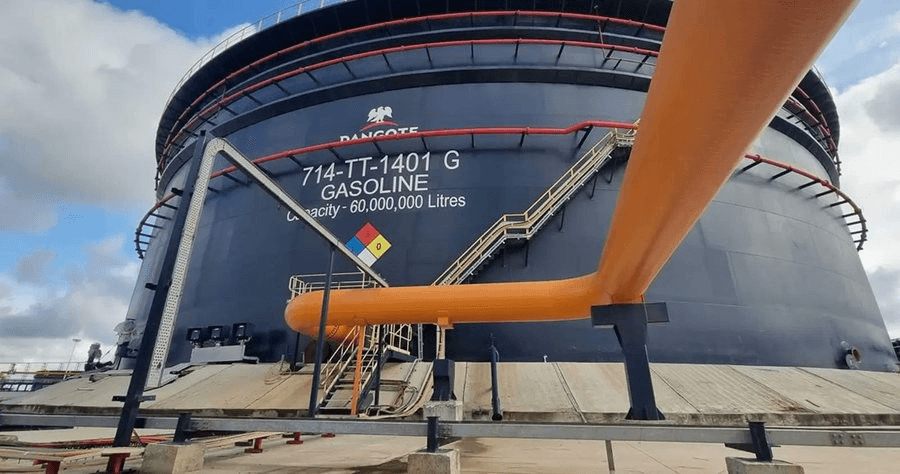
Dangote Petroleum Refinery’s three upward reviews of its Premium Motor Spirit (PMS) price within eight days were linked to crude procurement costs and the time between purchasing crude and processing it into finished products, according to sources familiar with the refinery’s operations.
A senior executive of the refinery, who spoke with The PUNCH on condition of anonymity because he was not authorised to speak publicly, said the refinery’s pricing decisions were influenced by the cost of crude already purchased and delivered for processing, rather than solely by movements in international crude benchmarks on the days the price adjustments were announced.
The executive explained that crude procurement was not an immediate transaction tied to the price quoted in the international market on any particular day. Instead, the process involves negotiating and completing a purchase, securing a loading window, chartering a vessel, loading the cargo, and transporting it to Nigeria before securing a berth and discharging the crude into storage.
He questioned whether a refinery could realistically buy crude at the prevailing daily price and immediately process it, given the time required to complete the various stages of procurement and delivery.
The executive also drew attention to crude already purchased and stored at the refinery, noting that large volumes could have been acquired when international prices were higher.
According to him, this inventory becomes an important component of the refinery’s pricing decisions because reducing the price of petrol solely on the basis of a subsequent decline in global crude prices could leave the refinery selling products made from higher-cost crude at a lower replacement-cost benchmark.
The explanation comes after Dangote Refinery raised its PMS gantry price three times in eight days.
The refinery increased the price from ₦1,165 to ₦1,185 per litre on August 21. Five days later, it raised the price by another ₦15 to ₦1,200 per litre, effective August 26.
On August 29, the refinery announced its largest adjustment within the period, increasing the gantry price by ₦65 to ₦1,265 per litre.
The three reviews resulted in a cumulative ₦100 per litre increase from the August 21 level, equivalent to an increase of about 8.6 per cent.
The latest adjustment also raised the refinery’s coastal PMS price from ₦1,582,380 to ₦1,669,545 per metric tonne.
Dangote’s explanation places crude procurement and inventory costs at the centre of the price changes, rather than treating the international crude benchmark as an immediate pass-through to the pump price.
This distinction is significant because crude oil prices can change considerably between the time a cargo is contracted and when it arrives at the refinery. The cost incurred by the refiner therefore reflects the price and associated logistics attached to the cargo being processed, rather than necessarily the spot price prevailing when the finished product is sold.
Data from the Major Energies Marketers Association of Nigeria’s Energy Bulletin showed that Dangote’s PMS gantry price was ₦1,200 per litre as of August 27.
The bulletin also put the estimated spot import-parity price of petrol into tanks at ₦1,222.32 per litre, while the NPSC-NOJ spot estimate stood at ₦1,221.32 per litre.
At that point, Dangote’s gantry price was ₦22.32 below the estimated spot import-parity level.
The subsequent ₦65 increase two days later took the refinery’s gantry price to ₦1,265 per litre, placing it ₦42.68 above the August 27 spot import-parity estimate. However, it has not been established whether the import-parity benchmark remained at the August 27 level after the latest price review.
The refinery also directed customers to return their existing Authorisations to Collect for repricing, after which new volume contracts would be issued to enable loading to resume.
The repeated adjustments have nevertheless raised concerns among petroleum marketers, particularly over the difficulty of planning inventory purchases when replacement costs change rapidly.
Chinedu Ukadike, National Publicity Secretary of the Independent Petroleum Marketers Association of Nigeria, said marketers were being affected by a combination of international market conditions, government policies and exchange-rate movements.
He said marketers could not determine the underlying refinery price because they were not refiners, adding that the frequent changes were making it increasingly difficult for businesses to structure their operations.
Ukadike noted that Dangote had previously responded to movements in international crude prices by reducing its product prices, but said the current level of volatility was creating uncertainty for marketers.
He also linked the instability to continuing geopolitical tensions, warning that prolonged uncertainty surrounding Iran and the United States could contribute to further fluctuations in petroleum prices.
The pricing issue is further complicated by Dangote Refinery’s crude supply structure. Reuters reported on August 26 that between 30 and 40 percent of the refinery’s crude feedstock was being imported, meaning part of its production costs can be influenced by international crude procurement, shipping and associated logistics.
The refinery’s latest explanation therefore highlights the lag between crude acquisition and finished-product pricing as a key factor behind the three PMS price reviews, while market participants continue to assess how changes in global crude prices should translate into domestic petrol prices.
For consumers and marketers, the central issue remains how quickly changes in crude costs are reflected in refined-product prices and how inventory purchased at different price levels is incorporated into the final cost of petrol.